
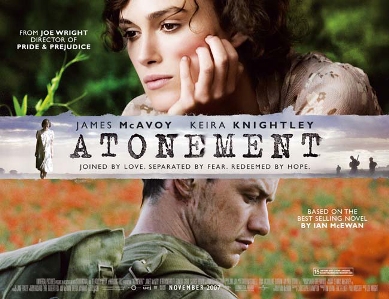
There was nothing on Netflix starring Audrey Hepburn that I haven’t already seen so I googled, “classics to watch on Netflix, current” and a list was summoned from the depths of the interweb. There were some good horror movies on said list that I definitely intend to go back and watch however that was not where my head was at. Scrolling down, I found what I was looking for: Atonement. Released in 2007, the film was adapted from the novel of the same name, published six years earlier by Ian McEwan. It met everything in my mental checklist: not set in the present, an amazing cast, and not a straightforward-spoon-fed romance. Holy shit lovelies, what a movie. What a journey.
Atonement tells the tale of what happens when a little lie turns into a bigger lie and the impact that has on those in the line of fire. What we learn first hand is that what you say matters and that even if you think you are a reliable narrator, you might not be. That doubt that you feel eats at you through life, through war, through death. Atonement tells us that there is no statute of limitations on taking responsibility for your actions.
We enter the lives of the Tallis family in 1935. Briony (Saoirse Ronan) is a young child shown from the start to have an active imagination. The film opens with her finishing a play she has been working on to be performed upon her brother’s visit home; younger cousins staying with the family are her unwilling actors. Having grown bored, said cousins exit Briony’s room. This is where the intrigue begins. Gazing out the window, Briony witnesses an encounter down in the yard, however, not having heard anything that passes between the two people involved, she is only able to infer in her youthful and fanciful brain what it was that occurred. Cut to the same scene, rewound, and told from the perspective of Cecelia Tallis (Keria Knightly) and Robbie Turner (James McAvoy). It is not an argument but instead an awkward encounter between two people who are unable and afraid to admit to their feelings for each other. Passion of a different kind from a different perspective.
Later that day, we are with Robbie as he writes several drafts of a letter to Cecelia; he is attempting to organize his thoughts. Finally satisfied, he puts paper in envelope and off he goes to deliver it. Spying Briony on the road, he asks her to run ahead and hand it off for him. It is only after she is gone from view that he realizes his terrible mistake, the wrong piece of paper had been sealed within. Of course, Briony rips open the envelope and reads the words that Robbie never intended for anyone to see. From this she links the “argument” she witnessed earlier and jumps to a horrible conclusion. There is too much adultness going on for her little mind to handle and she begins to form a very wrong sense of what is going on. We are privy to the fact that Robbie lets Cecelia know of this mistake, we are privy to their professions of love for each other, we are privy to the truth that alludes Briony.
Dinner is a brief and uncomfortable affair interrupted by the realization that the two youngest cousins have run away. The party breaks up to cover the estate’s grounds looking for them. It is during this search that Briony bears witness to the third act of the day that she does not understand and which overwhelms her. A character is molested and Briony witnesses the attacker running off without, as far as we can tell, clearly seeing his face. Again, conclusions are jumped to and when interviewed by the police she points fingers in the only direction she can think to point them. Robbie is wrongly accused of rape. However, due to his low station and Briony’s telling of events, Robbie’s protestations are not believed and he is thrown in prison.
Several years have passed as the next scene opens and we are in the middle of WWII in the heart of Germany. Robbie was given a choice, continue serving in jail or go out and serve for the country. Imagine being forced to war based on the lies of someone who just didn’t understand. It is here that we are brought to see the severe consequences of Briony’s actions and how they are impacting everyone in her life. Her sister has stopped talking to her; their childhood friend is fighting in the war; and she has foregone a classical education, seemingly fearing and cautious of the misery brought upon her by her imagination.
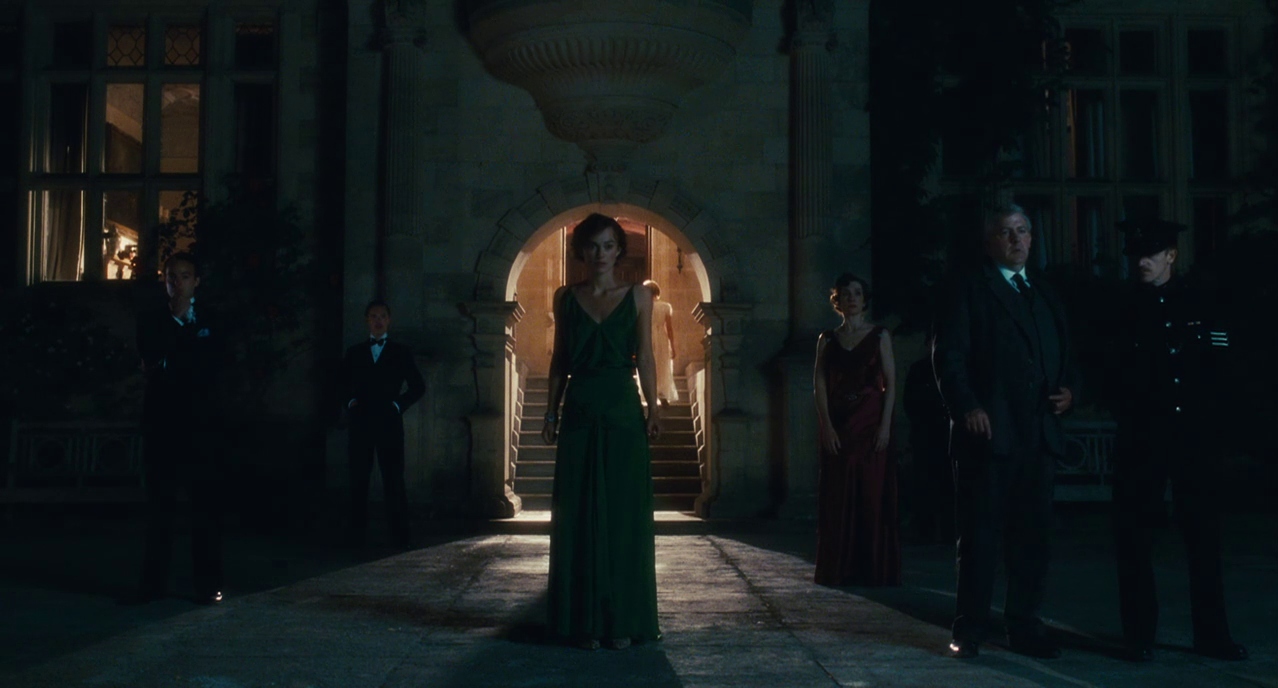
There is of course more to the story than the events I have just outlined. However, in an effort to avoid spoilers, I won’t say any more on the direct plot points of the tale. Instead I would like to touch on the importance of truth and the viewer/reader’s ability to rely upon the narrator. The whole truth and nothing but the truth is a hard thing to muster. Whose truth is it? Yours might be different than mine, does that mean that one of us is wholly wrong? Is truth subjective or objective? How do you know if something you think is true, actually is true? These are all important questions and not all are easily answered. Briony spends the rest of her life trying to make up for (atone for) her grievous mistake. If we had spent the whole movie viewing events from just Briony’s perspective, we would have no reason to think of her as anything but a reliable narrator. Although due to the fact that we also see things from Cecelia’s and Robbie’s perspectives, we know that our primary narrator is not fully knowledgeable about things to which she states with confidence and selfassuredness. We go through the rest of the film seeing the butterfly effect of one lie. We, along with Cecelia, are unable to tell if anything Briony says is “just the truth, no rhymes. No embellishments. No adjectives.”
In addition to the beautiful unfolding of the plot of this movie, the sound design is breathtaking. The film won an Oscar for best original score and rightly so. There is more to it though than just the music which is a mixture of compelling classical tunes relying heavily upon the piano and one or two note themes and the ambient sounds of everyday life. The twitter of birds in a wide open field. The hum of a plane far overhead. Most importantly and keenly throughout the film, the tap tap of a typewriter. This specific sound sets the tone in many scenes, either speeding up or slowing down to highlight the pace of the moment. Never before have I felt more aware of character’s surrounding due so heavily to the sense of sound. Hearing what they hear in a moment of otherwise silence pulls you farther in to the scene with them.
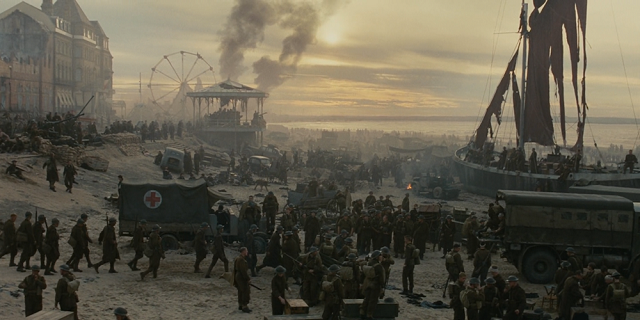
There is a scene on the beach of Normandy which is one long shot and the sounds that you hear as you follow Robbie and his fellows through the ravaged shore draw you so directly in: the shooting of horses that they can’t take with them, the cry of men and the silence of men, the songs being sung in loud chorus to comfort each other and get through to the next light of day. I realized by the end of the panning that I had been holding my breathe because I was feeling the same sense of hopelessness and dismay that had overcome those on screen. In addition to setting the emotional toll for the scenes, the music was also set nicely to match up with the changing of shots so that the pace your eyes kept was the same as the pace your ears kept.
The storytelling found within this movie is absolutely captivating. From the amazing cast to the heart-wrenching tale, Atonement is a movie that should surely be added to your must watch list. Be prepared to watch it though, not only is it heavy on the mind, it is also heavy on the run time clocking in at just over two hours. It is worth it my friends, oh is it worth it.
 that ending though