The best part of getting lost in a world (be it through a book or a film) is that anything can happen. Certain storytellers have the ability to submerge their audience in world’s that can be very similar to ours or very, very different. It is not just that full characters are created or that the story line is well thought out and planned, it is that every aspect of the world is notably considered and taken into accordance within the story’s unfolding. A writer who is able to convey the mores of a culture which they’ve created or enhanced without shoving it down your throat via clunky exposition is a talented one indeed. This is most evident of series in that there is so much more time for customs to be laid out and histories to be relayed. Tolkien took up volumes with the detailed history of a whole land as did Paolini. Lewis built his world volume by volume which allowed for a slow expansion and understanding of the world in which Narnia existed. I think this is why The Magician’s Nephew has always been my favorite. This world building is something that I am noticing more and more as I tear through the Game of Thrones saga (I’m currently in book three) and also something I noticed recently while watching the latest installment of Disney’s Pirates of the Caribbean films. I realize I may lose some of you there. What?! The Pirates movies are being thought of in the same breath as GoT?! Hear me out, lovelies.
When considering a fully realized world, we are able to recognize geography and history yes but there is something else that is also important. The rules of the reality of this alternate-verse are very important to establish so that the author knows what is and isn’t possible and so does the viewer/reader. Rules within a world establish these parameters so that characters experience events with logical outcomes, so that there is a reason when crazy events happen, and so on. What got me thinking about the importance of this was watching the latest (and hopefully last (although through my research I see it won’t be the last)) installment of the Pirates movies.
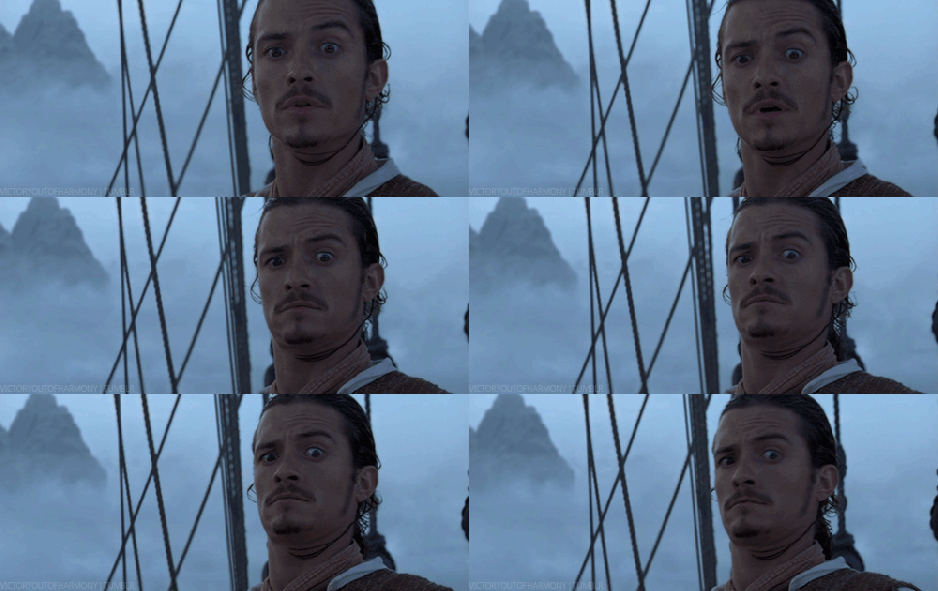
Over the course of the five films that make up this series there are many things that happen that in our reality would not be possible. From the very beginning of the first movie we are let known that curses and magic are real. This is evident even from the title: The Curse of the Black Pearl. Thus begins our education into this world. We are taken in to a time that existed (early to mid 1700’s) and a place that is real (the Caribbean) however the reality is altered from ours. Having Will Turner (Orlando Bloom) as our primary guide through the events of the first film, we learn as he does about the lives of pirates. To start, Turner is pretty landlocked in his life and does not know much about pirate culture. It is only once his love Elizabeth Swann (Kierra Knightly) is abducted by pirates does he get pulled in to the mysteries of the sea. We see with Will that curses are not to be trifled with and that they are indeed very real. Once out at sea, we learn that most of the terrifying tales told by sailors have some sort of basis in the sea’s reality. Monstrous creatures of lore like the Kraken do exist and the boogiemen of your dreams like Davy Jones are real and perfectly able to getcha! As we adventure along with Turner and Jack Sparrow (Johnny Depp) we almost become used to the fact that, yeah, of course they’re encountering monsters. Because of this I feel we almost become jaded in a sense through to the latest installment in which our leading lady Carina Smyth (Kaya Scodelario) is thrust into the mystical world that revolves around Jack Sparrow. There is a point when Carina finally sees something supernatural. She screams and runs out of the water and up the shore shouting that ghosts are real. An appropriate reaction, honestly.
This moment is what really got me paying attention to the world within these films. Because of this moment I realized how prevalent these mystical adventures are in the lives of our leading men and I realized something else too: they all take place far out at sea. We are along for the ride with these men seeing pirate royalty convene for a summit; witnessing undead men, monkeys, and sharks; boarding ships that have been sunk for hundreds of years. These things are very real in this world however there is a whole population who is unawares of their existence. This is a part of the rules of this world. Creatures whose presence cannot be explained shock those who are not used to them (which is again, appropriate). Even when a character becomes used to these things and is part of the pirate life there are still instances where one of them will see something and have wtf moment.
Another saga that I am currently immersed in is that of A Song of Ice and Fire. With five books published and seven total promised, George R. R. Martin has created a whole universe with its own precedence and standards. The history of Westeros and the surrounding lands extends for thousands of years and with one continent and many island countries, the make up of these lands is vast. In fact, there is so much history to cover that in addition to the primary novels that make up the saga ASoIaF, there are also several novellas that give us further knowledge of different times within this world that we come to know so well. Because there are many houses and each of them have their own pasts (in addition to a global history of wars and times of peace) there is an endless amount of possibilities for characters we already know and for those whom we have not met. But again, it is not the characters that make the rules of the world.
Much like our world and that of the world in Pirates, there are laws of reality that must be followed. Due to the fact that there are many different cultures that we are encountering, there are several different realms in which people exist. Those who live in the far North have very different lives than those who live in the far South and very different again from those who are Dothraki or Lyseni. While there are many different realms there still is only one reality within which everyone operates. It is established within the prologue of the very first book that otherworldly magic exists but is not wholly understood by persons at large.
Something interesting that Martin has done in this land is to establish that there are old gods, ancient myths that revolve around the First Men; new gods, known as the seven; and a Lord of Light, who is very mysterious [and seems somewhat cultish]. I find this compelling as it is a small similarity to our own world in which many different religions and schools of thought exist. Because of this, we are able to see very quickly that the many different regions of this land operate under different beliefs. Most often the new gods are mentioned. Those who worship in this manner visit the Sept to pray to one god who is represented by seven faces seen as the Mother, Maiden, Warrior, Father, Crone, Stranger, and Smith. Each of these are prayed to for different reasons: to keep a son safe in battle, to keep a woman safe during childbirth, etc. Then there are the old gods, worshiped in the North by the first men and by some who live still. There is a magic in this belief; a connectivity to the forest and all its creatures. The wierwood trees in the forests and in the godswoods of castles and forts create a conduit of sorts for these gods to see through and be prayed to. Lastly, there is the Lord of Light, who is said to show his true believers the way if they stare into the flames of fires. The character Melisandre is who [largely] leads us through our knowledge of this particular religion and because it is not widely known or practiced in Westeros, many men distrust this vein of thought and see it as witchcraft. That last bit is interesting. The fact that the Lord of Light’s followers are mistrusted because of their “devil worship” or “sorcery” draws attention to the fact that magic is not something that is trusted in this land. The gods of old seemed to posses some magic but their times are long gone and there doesn’t seem to be any magic left in the world. That is, until dragons are born and a crippled boy becomes the keeper of knowledge past and present.
Aside from religion, there are other aspects of the world of Westeros that are outlined to establish the world. In battle, men die (whereas as pointed out above in the Pirates world, ghosts exist). There is a hierarchy that exists by which the land is governed. Despite the fact that there is a very large scale war going on for the Iron Throne, there is a system in place: lords, wardens, etc. Culture is explored through songs sung by bards and tales told around the campfire. It is fascinating to me how deep and rich the history of this land is.
Getting lost in a world that is not our own is part of what makes reading and watching movies so compelling. We are able to escape our lives for a span of pages/the run time of a film and truly be somewhere else. The greatest storytellers create fully realized settings to further allow for this escape and totally submerse their audiences. While it might be easy to create a tale, coming up with the entire world is what makes the escape successful. Whether it is building the world from scratch (example: Lord of the Rings) or slightly altering our reality to make it their own (example: Inception), an author who takes the time to think out all aspects of their world is a skilled one indeed.



 that ending though