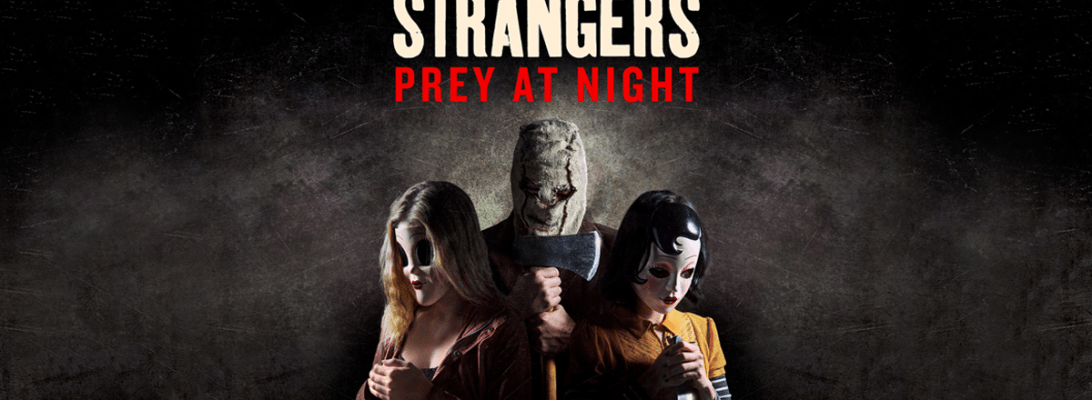
The unnecessary sequel

The-Strangers-Prey-at-Night-for-Blog


Major, major spoilers below.

It is rare that you will find me with a whole day to lounge on the couch with nothing to do, rare indeed. But, when it does happen, I will gladly watch crap film after crap film for as long as I can stay awake. This was exactly how my one day off a week was spent this last week. Sometimes, you’ve really got to listen to your body and sit still, damnit! So, with that being said, one of the movies I watched was the newish sequel to The Strangers which is by far one of my favorite horror films of all time. I rank it up there with Cabin in the Woods and the original Jeepers Creepers. That being said, part two was TERRIBLE.

The Strangers came out in 2008 at the height of the midnight premier craze. I distinctly remember driving home to my brand new student apartment after watching the movie. None of my roommates had moved in yet so I had this giant apartment to myself. It was really creepy! Now, this apartment was in a gated community, not in the middle of nowhere, and not on the ground floor. All of these things added up to mean that I was probably Not going to be the Strangers next victim. What the movie had done so well was keep everyone in the incredibly small cast in the same small area for the whole movie. There was no escape. And in the end, knowing that there was no way to ever identify these killers. Was this a real crime? Could the killer still be out there committing these atrocities?

The open-ended ending was perfect. We see them drive away but we don’t know if they keep on killing, if this was their first, and on and on ad infinitum. Their identities were never revealed and they remain at large which makes the conclusion perfect. It leaves you wondering but not necessarily wanting more.

What is most eerie about the stranger’s taunting of Liv Tyler and Scott Speedman in the original is that they are slow and in control. This is evident even in the way the scenes are shot, never too wide, there is always a bit of a cramped feeling – like there is no escape. Even when they are outside and running between the main house and the barn there are not too many wide shots. Additionally, they never feel unattainably unkillable, just like they have a better handle on things. They were planning mayhem after all and Tyler and Speedman’s characters were just looking to get some sleep after an emotionally taxing day. There were three of them, so the fact that one would knock on the door and another would be in the back is a totally plausible course for their actions. But they were timed realistically and never did anyone receive an incapacitating injury and then get up and further persist in their killing. Slow and deliberate.

Now, take all of that mastery of action (both in the writing and the way it was shot) and throw all of it out the window.

In the latest iteration The Strangers: Prey at Night we are taken to another remote location, this time with a family instead of a couple. Christina Hendrix and Martin Henderson play mom and dad respectively and Bailee Maddison and Lewis Pullman are the children. All of them have a pretty good chemistry and the dialogue seems natural, especially between Hendrix and Henderson. But that is where my praise ends.

The scripts were written by Bryan Bertino in both cases so I’m not sure where things start going wrong.

In Prey at Night the scene is set at an abandoned for the offseason trailer park. We begin by seeing the strangers’ killings in this park, more of what seems to be their at random killing. It is only after we gain a bit more insight that we realize that while these killings were occurring, Hendrix’s character calls and leaves a voicemail for a now dead family member, alerting the strangers of their imminent arrival.

WE’RE HERE! READY TO BE KILLED!

So, one of the aspects of the original is that we know there is going to be death, we see it in the opening of the movie, but there is not an actual murder scene until the very end. This slow build is what makes classics like Halloween so great, the building energy and anxiety felt by the audience inspired by small almost gotcha moments and chilling music. With PaN we get murder right out the gate so now we know the family is driving to their deaths.

A knock on the door of the trailer they check into prompts a question we are all familiar with, “Is Tamara home?” Nope! Bye! The porch light is unscrewed so we have the same, in the shadows, effect as in the original. Of course, after this creepy encounter, we still have the EVERYONE IN THE FAMILY thinking it is a good idea to split up. NO! STOP!

So as everyone begins traipsing across this giant trailer park, the four family members come to realize there are three masked people after them (Man in Mask, Pin-Up Girl, and Dollface). Maybe splitting up wasn’t great after all. As they all run around, the camera is consistently at a wide angle showing one of the strangers in pursuit of one of the family. This takes away the intimate feeling of them being right there and able to “getcha” as was the feeling throughout the whole entire original.

There is one exception to this when Maddison’s character dives into a tunnel on a playground in which there is a scene framed to misdirect you: Man in Mask has headlights pointed into the tunnel and out of nowhere Pin-Up appears and provides a pretty good jumpscare.

However, this leads me to my very next point. Up until the end of this scene, the chase had been between just the two of them [Man and Maddison] and then Pin-Up just appears out of the other end of the tunnel. The reason this is so irritating is that you have seven characters running willy-nilly through this park: hiding, seeking, double-digit numbers of trailers to choose from, playground, woods, clubhouse all of these different places and yet everyone is always one corner away.

IT’S IMPLAUSIBLE AND IRRITATING!!!!

At least twice, if not more, there are chase scenes that just don’t make sense because there is a queer ability of the strangers to just be there. Up until the very end when there is a car crash and a fireball engulfs both vehicles. It’s not just One shotgun shot you need to kill them, it’s Two! There becomes an unnatural persistence that by the end is just like, reaally?!

In the original movie you knew the strangers were there, hiding just out of sight. In this movie they literally pop into sight so quickly you don’t have time to breathe. The films have the exact same run times yet the pace of each of them is totally opposite. You’ve got a slow and steady demise of the main characters, stuck in one house with no escape…and then you’ve got a round-em-up chase story that doesn’t really match with the M.O. of the first.

Bertino has said that he wondered what it had been like inside the house for the Tate’s while the Manson family was murdering them. What was the victim experience as opposed to a cop piecing it together, getting it straight from the encounter? Now, just those two sentences have your mind wandering, don’t they? That is what the original feels like. Clausterphobic. No escape. No nice ending…you know the ending from go. Death. So final that we see the strangers from behind as they take their masks off and you know for certain that the end is nigh. However, one final wrongness of Prey at Night is the taking off of the masks and the way that those scenes play out.

I really hope there is not another movie in this series.

I’m done ranting now.
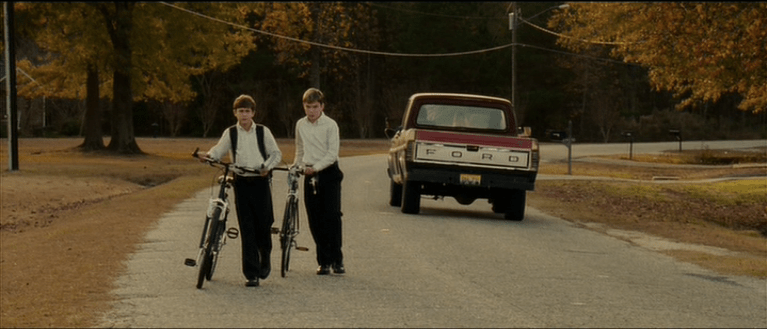
 

StrangersTruck


.

Penny Dreadful – Showtime

published penny dreadfuls

Gothic literature is a beautiful thing. So easily identifiable and so filled with hidden meanings, psychological and supernatural intrigue, and lessons to be learned. My undergraduate degree is in English Literature and I took more than one class on specifically Gothic Lit. My most frequently recalled example of the genre is The Yellow Wallpaper published in 1892 by Charlotte Perkins Gilman. Not only is the story itself a trip but it is also a work published by an American, proving that the genre is not solely ruled by the Europeans. Gothic literature has a rich history that spread across many countries in the mid to late 1800’s. Classic conventions of the genre include horror/supernatural elements, death, and the macabre. It often times includes a female protagonist who is dealing with some sort of psychological disorder. Many female writers of the time used the genre to have their voices and perspectives heard on issues that would otherwise be swept under the rug. There is typically a setting in these stories that takes on more characteristics than just a normal scene. Embodying histories and feelings and usually certain architectural elements, these settings become as much characters as the people within the stories. The literary scene in the 1800’s was booming with tales of the supernatural. From Mary Shelly’s Frankenstein (1818) to Bram Stoker’s Dracula (1897), and Oscar Wilde’s The Picture of Dorian Grey (1890) there was no need to look far for tales of monsters who walk among us. In these times, printing and publishing were very expensive and so stories were often serialized and published in magazines on a weekly or monthly basis. The stories would be eagerly anticipated and provide a brief escape from the world around them. In addition to these works, there were also shorter works published for pennies and made available to even the poorest of the poor. These penny works became known as penny dreadfuls for the gruesome and dreadful tales depicted within. Beginning in the 1830’s, penny dreadful tales included reprintings of classic Gothic literature such as The Castle of Otranto as well as new pieces of horror like Sweeny Todd: The Demon Barber of Fleet Street. 

Fast forward to the new millennium and people are still enraptured by tales with these dark and classic elements. Enter Showtime with their series Penny Dreadful. For three seasons we are taken through a classic Gothic tale all the while pulling in more and more of the characters that were made so famous in the 19th century.

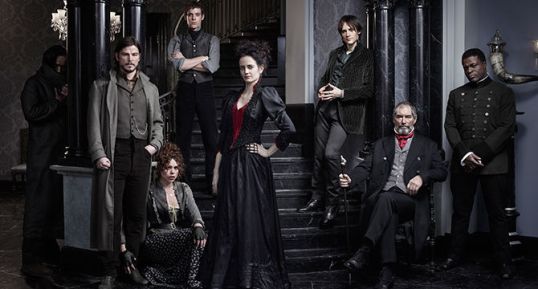
Penny Dreadful cast

While this tale is being spun, we are introduced to Ethan Chandler (Josh Harnett), Ser Malcolm Murray (Timothy Dalton), and Vanessa Ives (Eva Green) as our three main characters. While these people individually are not part of the established canons of the tales from which the show draws, they make up the central ring of the spider’s web. Malcolm Murray’s daughter was Mina, a name that should sound more familiar to you. Mina has been missing for some time now and Vanessa, in the first season, begins getting these visions and feelings that Mina is trying to reach out to her. Thus begins the supernatural quest in this Gothic tale. Ethan Chandler becomes their gun for hire as Ser Malcolm and Vanessa begin to explore what is happening to Vanessa. Together, the three of them delve deep into psychic connections, seances, and the biggest quagmire of them all: the fight between good and evil. As our guides become more entrenched in this world, it is clear that they will be unable to unearth truth and answers by themselves. When Vanessa becomes fully possessed and in need of medical attention, the good doctor is called for. Enter Dr. Frankenstein (Harry Treadway). As the realization of other worldliness enters, so does the famous hunter Van Helsing (David Warner). The spider’s web broadens and so too does our scope of the supernatural in London. Between demonic fits, Vanessa is a part of high-ish society in London and one of her social circles brings her close to a beautiful and charming man. Dorian Grey (Reeve Carney) does not get much interaction with the other characters in the beginning aside from Vanessa however in the latter part of the series his immortality is matched by that of another character’s and the tragedy that unfolds in that story line is heart wrenching.

Witches appear, a wolf man is present, and a darkness is descending on London.

The ability of the writers to bring all of these characters from different Londons into the same time and place is really well done. With three seasons to complete their tale, the overarching plot is well paced and there are not really any loose ends by the time it wraps. What I loved most by the end is that you as the viewer are so clearly able to see that this is a tale of tragedy for everyone involved. There is love and there is death and everything that comes between. Part of what makes the tales of love so great is that they are not all strictly between one man and one woman as a conventional love story might portray. For example, Vanessa is not related by blood to Ser Malcolm however he loves her like a daughter and is supremely concerned with her well-being. Dr. Frankenstein shows a deeply reckless and morbid sense of love for his creations (of which there are ultimately three). His love is not responsible or ethical yet it is deep and honest and earnest. Frankenstein’s moral journey through the three seasons plays out without the knowledge of the three main characters and so his evolution is largely just between him and his creations. Vanessa’s love for and belief in Christ is a very important thread in this web as it allows for the entry point into our story of the war between God and the Devil. Dorian Grey’s love for himself and all things beautiful brings into the story questions of being comfortable with and loving yourself. He is alone even when in the midst of a crowd and there is a woman who enters who helps him relearn this lesson and realize the importance of self. Lily (Billie Piper), the woman I just mentioned, is an amazing and breath taking character. Her strength and will inspire women around her, who she draws in like the spider I keep referencing. She comes to us in season one as a whore, lowly and taken advantage of, and by the time she is reborn and brought back in to the world with a strike of lightening, you are able to see the layers and layers of trauma that haunted her in her past and shape who she is in the present.

Then there is death. Lots of it. Dracula, the Wolf Man, Frankenstein’s monsters, they are all in the city at the same time and woe is the human who gets in their way. The vampire feels no remorse for his kills. He is above humans and views them as pawns and food. However, the other two monsters I mention are creatures with deep awareness of and remorse for the kills they chalk up. One of them is unaware of his monster as the wolf takes over the human, blotting out the humanity which guides the man and letting in the animal instincts which make him a wolf. As we get deeper into the lore and backstory of the wolf and how he came to be, elements of American Indian histories are included and explained. This to me was very interesting as it was such a sharp deviation from the Victorian lore that had been the backbone of the story thus far. Frankenstein’s monster (Rory Kinnear) names himself John Clare after the poet and is a beautiful soul of a soulless creature. His journey is largely apart from the main tale as Dorian Grey’s is. We know nothing at the start of his tale of this man’s past. Who he was and how he had died is as much a mystery to us as it is to him. John Clare does some killing of his own out of rage and necessity of certain situations. Through his rage he learns that this ability to “turn in to a monster” really scares him. He looks enough the part, he doesn’t want to play it too. Deep down, he is a gentle soul who likes to read and loves poetry. We are able to see the hurt he feels when people are scared of him, the pain he feels when someone reels at the sight of his face. He is a walking tragedy in and of himself.

Penny Dreadful is one of those shows that seemed aware of it’s time frame and conscious of the arcs of each character. Thus, the story is a complete one with a defined beginning, middle, and end. A beautiful tale which breaks down how well we know ourselves, how we care for those around us, and how events in our lives effect those around us. Vanessa Ives’s awareness of everyone in this universe (she is the only character who has verbal interactions with every single other character) is a way for us all to see the chain reactions our actions have on those around us; she is the female protagonist with the psychological issues after all. The light and dark pull felt throughout the show is a constant reminder of the forces of good and evil at work within us all. Additionally, there are metaphors out the wazoo in this series, such as many scenes being shot in mirrors, the allusions to spirit animals, and the divine at work through humans. All of these elements make it a very successful telling of many Gothics we are already familiar with. What an amazing show, you guys. A definite must watch.

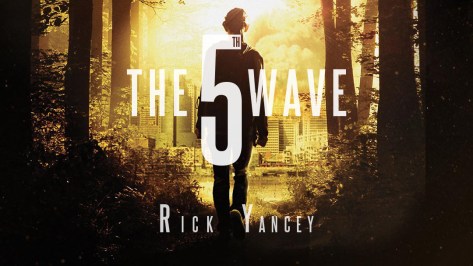
The 5th Wave – Rick Yancey

the5thwavebook


Well wasn’t May just a kick in the pants, lovelies?! Life was hectic in general but to top things off I was bookless for almost the whole month. I think I started like four or five different books. These are books that I will eventually read (…she tells herself) but I needed something with a hook. I needed a tale that captured me from go. You know, that feeling that you get when you open a book and 10 seconds later you’re 60 pages in? That book that calls to you when you’re not reading it…The 5th Wave did that to me. Rick Yancey does an amazing job weaving the overtaking of our planet. This book is horrifically terrifying. For example, are you currently not really a fan of birds? Do you think that angry children are actually super dangerous tiny humans? If you have fears like these, this book might be too much for you. But you should read it anyways because it is. That. Good.

Cassie Sullivan is our primary storyteller through whom we learn about the beginning of the end of the world. There have been four waves so far. First, all of the electricity went out. Second, massive earthquakes and tidal waves cause flooding of every coastline in the world. By this time three billion are dead. Next is a plague transmitted by birds that wipes out 97% percent of the population. As we walk through this world with Cassie, alone and terrified, we learn with her about what comes next in the invasion. It is, at this point still hard to imagine the magnitude of this end of days situation. As Yancey says in the book, a “single death is a tragedy; a million is a statistic.” The scope of this book narrows in and then zooms out again. So, many times, are you reading and just going through the pages and then you stop and reread a sentence and realize how truly horrible some of the things going on in this book are!

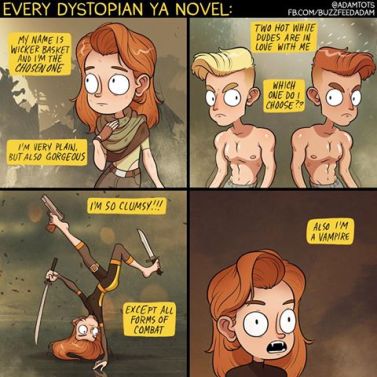
There are other strands of narration as well which add to the awareness of the horror. We get in the mind of an alien sniper, who wades through the aftermath killing any human he comes across; additionally you also have Cassie’s brother, someone she went to high school with, and a person who saves her. One element that creates and holds tension throughout is that They look like us (Obvi.) so even though you might know someone, how do you know you know them? You know what I mean? The whole book is like that!! Yes, if you really think hard you can figure it out as you go. But, if you’re just reading this to get excited about suspense that isn’t your standard Every-Distopian-YA-Novel a la:

YA Comic

then this is for you! I really was invested in each of these perspectives and what’s more, they didn’t spend their whole section/part being worried about “the girl” and not doing their own shit, as it is, ya know, the end of the world and what not. Themes of keeping promises and love being the primary driving force are present, yes. However, I thought they were done in great ways. There were times when I went, “oh come on!” when it was getting a little too formulaic but those issues straightened themselves out fairly quickly.

While we do get to see these other perspectives, I really appreciated getting to know Cassie’s voice. When we are first introduced to her she is on her own after her brother has been taken by uniformed men and her parents die during two different waves. She is trying to survive in a world in which, as far as she knows, she is the only one left alive. She is strong and focused after not having seen another person in weeks…or is it months? This uncertainty of time is something that Yancey plays around with very beautifully. Characters often think of time in relation to their actions and the happenings around them, seconds into eons when a bullet is speeding towards you, hours into years when you’re left alone in the dark. When you’re solo in the world, things can get screwy. The noticings about time are interesting in the end when you realize the grand scale of these aliens coming from who knows where and how far away…how long has this been in the works? And we as humans can only think in the smallest increments of time.

In addition to the time talk, there is often weighty, lofty things that only get said in books and movies that are somehow just on this side of okay. For example,

“Cassie Sullivan didn’t run…He could see the familiar look of fear in her eyes, a look he had seen a hundred times, the look we give back to death when death looks at us. “

Is quickly followed by,

“His heart, the war.

Her face, the battlefield.”

But it is all okay! I’m fine with goofy lines if the story is strong and the people have good solid reasons to be on these “missions” that they are invariably always on.

The gravitas of what these kids go through – because they are all kids – is disturbing. Imagine all of the adults in the world dying and the kids being taken in by some sort of military unit and being trained to hunt. They don’t know if they are being told the truth (and neither do you), nor are they old enough to really question things. Over the course of the fourth wave, you again realize what is going on and have to occasionally re-read paragraphs. Whether they are made to do these things by humans or Others, going through dead bodies and “processing” thousands for cremation is not something that should be on an eight year old’s to do list. Neither, for that matter, should weapons training and emergency medical/tactical care be subjects that should be taught to six year olds. You realize that these children, who are now parentless, are being guided by people who are not at all concerned for their well being or what is best for them. They are being trained brainwashed to kill. These horrors of the day keep tolling up and these kids are so glad to no longer be on their own in the middle of an alien invasion that they believe everything they are told!

Over the course of the entire book, you think for a section that you have something figured out and then the next chapter can go two ways: you could be wrong or you could be right which is sometimes even more scary. I haven’t read any of Yancey’s other works so I don’t know if he is just always good at suspense but man alive I am glad I fell into this book. There two books which round out the trilogy and I am anxious to start the second. I do know that there is a film that was made on the book in 2016 and I have heard nothing but terrible things about it so I haven’t as much as even seen the trailer. I wanted nothing to taint my experience of the book. This is an action that I am grateful for. There is also a lesson in that: don’t just watch dystopian thrillers. Read them. For an adventure that takes you to the end of the world and frequently punches you in the gut, pick up The 5th Wave.

Presidential – The Washington Post

presidential-podcast-2100_gw.jpg


Hello there, y’all! Happy President’s Day or happy two-days-early-birthday to President George Washington! On this happy day while Congress has been given the week “off” I encourage you to take a look at the presidency in a different light. The Washington Post, beacon of truth that it has been through the decades, has a new(ish) podcast out which is really rather enjoyable! I’ve never talked about a podcast on this here blog but, much like with audiobooks, if you’re ingesting words, it counts. Like books and movies, they are a way to escape reality for a moment.

Presidential goes episode by episode through each president’s tenure in office while looking at various aspects of the make-up of these men. What discerning character trait did John Adams have that allowed him to follow after Washington stepped away from office? Who is overlooked and why? The introduction of the “campaign”. These episodes are chalk full of little tidbits that you didn’t know about the Founding Fathers, the presidents during the Era of Good Feelings, and up through the present. Our host Lillian Cunningham is a reporter at TWP and her guests are people like the keepers of the keys at the Library of Congress, Pulitzer Prize winning historians, and Bob Woodward. There is a running question throughout the series where Lillian asks the historian on what it would be like to go on a blind date with the episode’s gentleman. Pieces like this really humanize these people some of whom lived over two hundred years ago.

I am currently on Andrew Johnson, president number 17 and I cannot get enough of these stories that are retold and relayed by these historians. Letters, diaries, and papers are all provided as sources for the information you learn in these episodes. For instance, AJ here was piss drunk at Lincoln’s inauguration and gave a really embarrassing speech…weeks later he was sworn in after Lincoln was assassinated. John Quincy Adams was the first son of a former president to hold the office and was also the only man to hold elected office after leaving the presidency. He went back to Congress and worked hard to fight slavery. In fact (this is one of my favorite recountings so far) there was a motion to make the word “slavery” illegal on the floor as it was becoming too much of a hot button issue in 1836. JQA went and got himself in trouble on purpose by saying the word. Now, as per the rules, he had a chance to defend himself of this action and he took advantage of this, his time to speak, and ran with it for TWO WEEKS talking about the injustices of slavery. This in and of itself is amazing and then as the story comes to an end and the episode is winding down we learn something else: who was a first term Representative at that same time but Abraham Lincoln. Bits like this make that whole thing so intricate and fascinating.

It really is amazing how far we’ve come in this country considering our government was put together by ideas proposed by men who didn’t really know what they were doing. George Washington espoused the belief that he was not fit to run the country and was firmly and vociferously  of the mind that he had no  idea what he was doing. We have been led by these men who have differed vastly in their ideals, these men who supported and encouraged the guidance of others, and whose legacies set examples for history. Our country has had its ups and downs (and there have certainly been a lot of both) and it is incredibly important to know where we’ve come from. How did we get from one to 44? How did we get to where we are now? This is monumentally important…to put it in presidential terms.

So whether you just listen to Obama and Kennedy or if you listen to them all in order, Presidential should definitely be on your radar.

…and so should this picture…

abraham-lincoln-sexy-photos-17.jpg


Late to the table: Arrested Development

arrested_development_cast_promo_photo

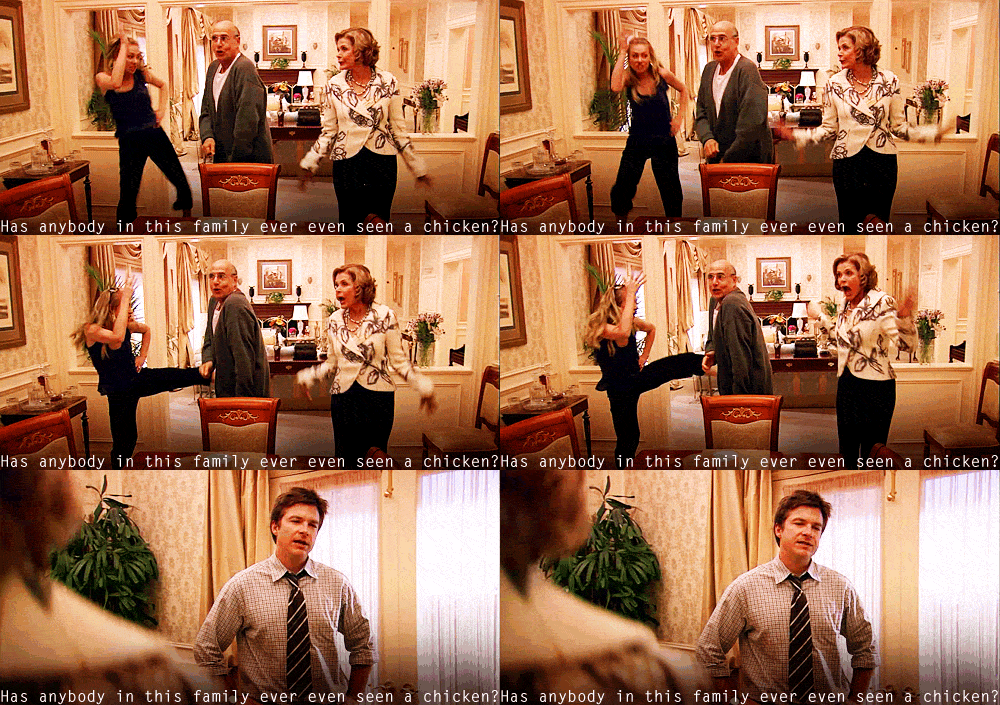
Upon scrolling through Netflix’s recommended section, I was repeatedly receiving Arrested Development as a suggestion. I had always heard great things about the original series…it was popular while I was in high school but I never got around to watching it. There is no question, now that I have viewed the series in its entirety that I don’t agree with the small masses that make up the cult following of the show. This entry though is specifically about season four. The “Netflix season” if you will. This season is also something that I had heard about …however nothing really good. At first, I must admit, I was in the same camp. The sets were slightly awkward as the show had been off the air for seven years. The dialogue was slightly off as if the writers and the actors took a bit to adjust back into their character’s grooves despite Mitchell Hurwitz (most recently he produced Lady Dynamite which you NEED TO SEE) returning to help co-write a majority of the episodes.

After tearing through the first three seasons in two weeks, I was hesitant after three or four episodes of season four. However, I couldn’t not finish it after all the time I had already invested. So, I soldiered onward and found that I ended it with a new found appreciation.

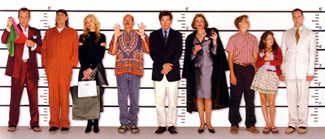
The Netflix season is structured differently than that of the original run. While there is still the premise of a show being shot about the family (complete with Ron Howard’s narration and the characters being aware of the cameras) there is one central storyline that unfolds and we see each character’s perspective; their side of the events. This creates a very interesting theme set around how each of their actions has impacts, sometimes unknown, on other people’s part in the story. It showed the interworkings of this family whom we have come to hold dear for reasons unexplainable. They are, after all, lying, cheating, connivers. What makes this way of storytelling even more interesting is that there are so many players involved and because of that so many avenues to explore. Including George Sr.’s twin there are 10 members of the Bluth family.

Picking up the storyline where it was left, we dive into the whole family being held in a police station after the events of season three’s finale. Lucille had tried to steal the Queen Mary, George Sr. had just been cleared of treason charges, Michael and George Michael had returned from their once again failed attempt to leave the family to their troubles, and many other pieces of the puzzle. Without explaining all of them: know that they were all there at this station. We bounce back and forth between the events here in the station and what comes after them with the understanding that it has been five years (not seven) in Bluth reality.

The through line slowly unfolds like like a bloom in the spring and each episode is labeled/assigned to a specific character. In doing this, you know that most of the episode is going to be dedicated to that character and the small degrees of separation between each person’s tale. It really becomes fascinating how something you do, it might be something small and insignificant to you, might effect someone else in a big way. It also serves to illustrate the seemingly isolated lives these characters live in that their actions so immediately impact each other. This way of unfolding highlights a couple of other points as well: those who don’t seem to have too much overlay (ex. Buster and George Michael) are brought together in the culminating scene of the tale (the night of Cinco de Quatro), and, while it is always insisted that “family is first” by the Bluths, each is in their own little world. While this is a fact we already knew from the original run, this sort of individual attention of their lives seems to showcase it even more.

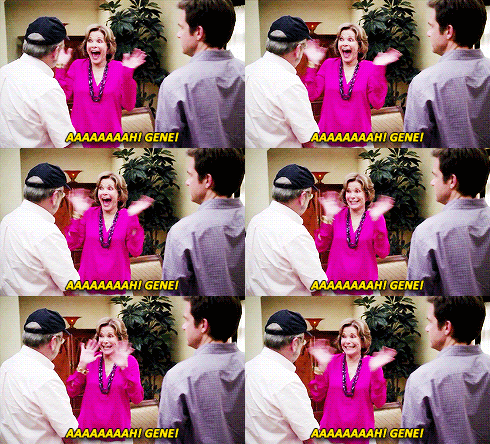
Outside of the interesting approach to storytelling, the reoccuring guests that appear over the course of the season really help give it a new feel despite old events occasionally being brought back up. There are familiar faces: Henry Winkler reprises his role as the Bluth family lawyer and is as incompetent ever, Gene Parmesan played by Martin Mull (the scenes where Lucille is surprised by his appearances make the whole show for me), and Kitty Sanchez the stage five clinger played to perfection by Judy Greer, and Liza Minnelli as the most unlucky neighbor Lucille 2. Then there are newcomers that bring even more charm and crazy to the table: Terry Crews as Herbert Love running for a seat in the House and Isla Fisher as Rebel Alley (an illegitimate daughter of Ron Howard). z1y2yyw

All of these elements: the story and how it unfolds, the characters new and old, and the awkwardness of the show in general made for what I found to be an enjoyable conclusion to our window into the lives of the Bluths. Again, all that being said, I totally understand where all the hate came from in reviews. I was really happy that I saw it through and didn’t give up.

What I take away from this experience is that even though Netflix Netflixed the season (made it shinier and a bit off), it worked. Now if only the same could be said for season two of Kimmy Schmidt.

  1. lcwqnsq

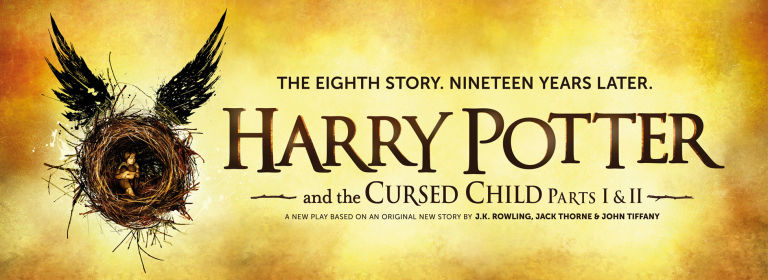
Harry Potter and the Cursed Child- Parts 1 & 2

gallery-potter-cursed-child-poster-1

I have, for many reasons,been putting off reading this playbook. When the series ended, I was content with its closing and was even glad of the epilogue showing that light can come to those who have faced the dark. This is one of the main reasons I was hesitant in picking up any sort of continuation of the story. That being said, I do think that there are so many tales that can be told from this world, which is why I am so excited about Fantastic Beasts coming out this week. So it was with much skepticism that I dove into Harry Potter and the Cursed Child.

HPCC was written for the stage by Jack Thorne and was based on an original story created by Thorne, J.K. Rowling and John Tiffany. A couple decades have passed since our trio left Hogwarts. Like we learn in the epilogue, Harry and Ginny end up together as do Ron and Hermione. Their kids are going off to school and it is here that the Potter’s middle child learns that he will be in Slytherin along with a boy who seems to be his only friend throughout: Scorpius Malfoy. The tale focuses on a couple of different parental relationships, how the younger generation are impacted by the past actions of their parents, and the importance of thought before action.

Albus Potter is the middle child. He often feels over looked and under appreciated. One night, in a heated fight, Harry accidentally comes back with a retort to the effect of “I wish you weren’t my son.” Ouch. This has a noticeable and obvious impact on the boy. Another important argument (this one Albus overhears and is not directly involved in) is had between Amos Diggory and Harry in which Amos blames Harry for Cedric’s death. All these many years later he is unable to accept the loss of his son and dwells on the fact that he was the “spare”. Collateral damage. The feeling of being the spare really resonates with Albus and he decides that preventing Cedric’s death would be a good course of action for setting things straight.

I don’t really understand this logic. This mission of his just doesn’t reeeeally make sense.

At this same time a Time Turner is discovered and taken in by the Ministry (oh yeah, Hermione is Minister for Magic, whaaaa?!) and isn’t this just perfect since Albus has decided that going back in time is exactly what he needs to do. How. Convenient.

So he and Scorpius go back in time to the Triwizard Tournament (a.k.a. book four). And wouldn’t you just know it but they mess shit up. Like really really badly. What frustrates me so much about this idea of theirs (which the story is largely based around) is that they are so inconsiderate of their actions and don’t even pause to think what undoing something that had happened two decades prior would do to the present. Preventing someones death that far back….I can’t even begin to fathom how many wrinkles that would produce. Which is why it seems so implausible. These kids have grown up in the wizarding world. Don’t you think they would be aware of the repercussions that something like this could have? I can see how there would be a counter argument formed: if they are living in a world in which all Time Turners had been abolished (/destroyed) maybe the perils of time travel weren’t taught to them. I don’t know. What I do know is that their ignorance sure does not create bliss.

When they get back to the present all sorts of things have gone haywire. So what do they do but decide to go back AGAIN to right what they’ve wronged. This time they travel to the second task and guess what…they eff some more shit up. When they get back to the present some people (including one of our main characters) weren’t even born! That’s how messed up things get. Also, Voldy is alive and well in this new present. Great. Now, to fix this, time must be travelled through…again.

This goes on and it is a total of four times that our characters traverse the time stream. Unbelievable.

A complaint that I have heard/read from many Potter fans is that the way Harry treats Albus doesn’t match up with the character we all grew up loving. I totally see where these thoughts are coming from. There are definitely some lines that I had to reread and recheck who the speaker was because it just seemed so out of touch. However, to that I say: Harry is a parent in this time. We have never before seen him in this role. So obviously there are going to be new facets of his character with which we are not as familiar. I mean, 20 years have passed, ya know? I definitely hope that some my 17 year old self’s traits evolve by the time I’m 37 (I’m about midway through that evolution and think things are going quite nicely…but I digress).

When all is said and done, I did not hate the read but I was not over the moon about it. It is very easy to get through because it is dialogue and stage direction and not any sort of expository “stuff” or narration. I would definitely encourage all Potter fans to check it out but I would caution them to go into it with an open mind. This is the story of Albus Potter despite Harry’s name being in the title. This is a play and not a book and as such should be viewed for what it is: a different medium. This is extensive fan fiction flushed out by Rowling and not penned by her. This is one to add to your Rowling shelf in the hopes that more stories (written by her or not) are to come.

This month in literature…

weekend-is-all-booked

Well hello there. I haven’t seen you in a while….totally my fault. Man, the past month has been crazy. To further interrupt the regular rotation of posts I’d like to tell you all about the amazing time I have had in the literary world over the past five weeks.

To kick off the month of October, the Texas Teen Book Festival was held. The day long celebration of the YA genre hosted 35 authors on the Saint Edward’s University campus. As I was volunteering, my day started just before 7 am putting up parking signs and helping to make sure school bus traffic went smoothly. Mindy Kaling’s book signing was the first event of the day which was to begin at 8:30 am. When I arrived (before the sun) there was already a crazy line waiting filled with so many amazing fans. Working book signings is one of my favorite things to do because the people are always excited to see these authors. YA fans are so appreciative of the authors in this genre and vise versa. Each author is so willing to converse with readers and makes sure that their experience in those two minutes is genuine. They have the rotation of these lines down to a science and know how many signatures they can do in x amount of time. It’s amazing. Another reason that this festival is fun is because of the games! Authors play trivia games, have races and contests. In addition to the panels that are held, many of them gather in the university’s gym and by the time you leave your stomach and face hurt from laughing so hard for so long. The Texas Teen Book Festival has been in operation and in a state of growth and evolution since 2009. The TTBF “fosters a community effort to celebrate and promote reading and writing by connecting teens to local and award-winning authors, whose writing spans across genres and interest level.” It is a wonderful experience to witness this first hand. While working a signing this year I overheard a conversation with Kirkus Prize nominee Traci Chee (The Reader) and a young reader who was probably in 7th or 8th grade. She told Chee that she wanted to be a writer and asked her very earnest and well put questions. How she flushed out characters. How to create a foil. This conversation went on for probably 20 minutes or so altogether. When another fan would walk up, the girl would move to the side and then come back and continue inquiring. Seeing this exchange made me so happy and that is the whole goal of such a festival: to inspire young minds and encourage them to keep reading, keep asking questions, and keep imagining.

The next big event: the Kirkus Prize. To read the full list of nominees and articles about each, visit the Kirkus Reviews website. When I was a young reader of about 10 or 12 I fell in love with this series that was about princesses and dragons. I have since forgotten (much to my annoyance) the name of the series and instead remember that the Kirkus review that was on the back of the book had been high praise. From that book on I didn’t buy a book unless it had a review from Kirkus. Imagine, then, how amazingly, stupendously, wonderfully awesome it is that I now work for Kirkus and speak with independent authors and small presses all day every day. Being part of the team who put together the ceremony for the Kirkus Prize was an experience almost beyond words. The ceremony was held in downtown Austin, Tx with a view of the skyline and a view of the river. Six authors in fiction, six in non-fiction, and six in youth literature (YA, middle grade, and picture books) were nominated for outstanding work in their genre. Making my way in and around the crowd, I spoke with several of the nominees and people within the industry that I have admired for so long. When I found myself in the presence of Jason Reynolds (who later in the evening won the award for YA) I totally fangirled on him. I was able to speak to him about his process, his upcoming projects, and about how great his work is. Again I witnessed the wonderful generosity of authors who want to talk about books just as much as you or I. The Kirkus Prize is the largest monetary prize in the literary world and as the first award of the season, it tends to set a precedent for nominations for awards that follow. The prize is $50,000 to each winning author and is awarded to the title that the judges feel displays exceptional merit.

The following evening was the 21st annual Literary Gala which is hosted by the Texas Book Festival. The gala serves as a fundraiser and is the driving factor in keeping the large festival free and open to the public. This was the first time I had been to anything that was coined black tie. Attending the gala this year was an amazing personal accomplishment for me as it was at this exact function the year prior that I met my future boss and started my path to Kirkus. Last year I interned for the festival and was on the outside for the whole gala. This year I was sitting at the Kirkus table and got to wear a fancy dress, eat an delicious three course meal, and listen to some pretty great speeches. One of my favorite aspects of the festival is the Reading Rock Stars program which goes into underprivileged schools in South Texas. They schedule author talks at these schools, bringing in authors and illustrators to talk to kids about what it means to them to be able to write/draw for them and how they too can do it! Each child receives a book of their own to keep and a lot of the time it is the first time that they are given a brand new book of their very own. To hear this program talked about at length during the gala was heart warming and inspiring. First Lady Laura Bush started the festival in 1995 and it has grown exponentially each year in both author and public attendance.

This month has been hectic and stressful and rewarding. It has been long and involved multitasking on a whole different level. And it was so worth it. Never before have I felt so satisfied with myself. I have worked hard for many years now to become part of this world and now that I am, I can’t imagine being anywhere else.

Thank you for reading my ramblings and for visiting my site. Next week we will return to our regularly scheduled programming.