
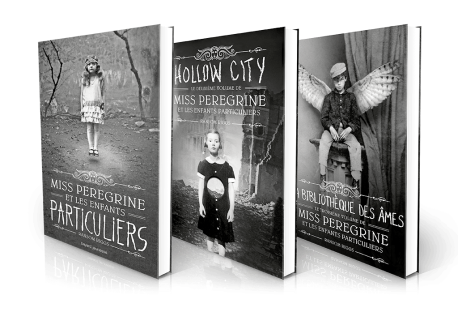
The first, second, and third novels of Miss Peregrine’s Peculiar Children are very darkly whimsical. Not in a Tim Burton way (I promise lovelies, this is the only time I will mention him) but in a sepia toned, phonograph, crackling edges kind of way; a way that progresses at juuust the right pace. Ransom Riggs brings us into a tale that you have to read to believe.
We begin with the self titled Miss Peregrine’s Home for Peculiar Children and Jacob Portman’s adventure from being a normal to realizing his a peculiar. As Jacob is our narrator we learn things about this new world, its history and its secrets, at the same pace he does. Which is why we are equal parts unsure of his grandfather’s sanity and the possible truth to the far out stories of his past when he dies a tragic death by a creature only Jacob sees. It is this traumatic event that slowly begins the chain of events that will open Jacob’s (and our) mind to untold possibilities and bring us to the time loop(s). We learn that Jacob’s gramps was a peculiar and so is Jake…they specifically can see these beasts that are ultimately Grandpa Portman’s downfall. Hollowgasts. They haunt peculiardom, eating the souls of any peculiar they can reach and are under the control of wights – the organized baddies. Anyway, peculiars. What are they, you ask? Who are they? Well, they are magnificent humans with the ability to do things like float, or have mouths on the back of their head, or create fire with their hands. I know your next thought: hmmm that sounds a lot like mutants. The thing is, these are all children…on the outside. The aforementioned timeloops are spaces on top of, or maybe behind, reality. They are little pockets that freeze a day and loop it forever; their inhabitants’s souls age however their bodies do not. This is where peculiars have taken to; unable to comfortably live in the open as wights and hollowgasts have hunted them for a century through the centuries. Not only are we introduced to this world in Riggs’s first title, we are also given brief glimpses of a much deeper narrative than just a boy grieving over his grandfather (that sounded dismissive but it is not meant to be) and finding his way back to the grandfather’s childhood home. There is the understanding that something serious is going on in these people’s worlds and we have arrived just in time!!!! (#savior) While the tone of this book is serious it has some moments of light. They are all still children: naive and living in a sunlit snapshot of time and when Jacob joins them he too has a lighter sense of self. As the book comes to a close we are promised that the understanding of and our perception of this time and place are about to be expanded even more. With a cliffhanger that leaves you thinking “Oh no!” there is no choice but to immediately pick up book number two.
Unfortunately it took me a whole year between buying the book and beginning to read it so there was a little remembering that I had to do which is okay because it picks up exactly where book one ended. Hollow City is the tale of Jacob and all of his new friends, Emma, Bronwyn, Enoch (et. al), on a rescue mission which has so many close calls you can’t help but speed through the book at the same breakneck pace. There is so much action and quick paced scenes that your eyes might not be able to keep up with your mind! We go from the sunny island of Cairnholm on which they have all lived for 60 years deeper into the loop to the same day but in London. The adventure of getting there and the people they meet gives us more insight into history and more is steadily revealed about this big bad. The fact that this is taking place during WWII is significant as the wights are able to pose as Nazis and no one thinks differently or realizes it. This allows them to be organized and systematically hunt down the entrances to these loops. They can’t go in, you see, so they employ traitors and trickery to get the peculiars and their guardians the ymbrynes to come out of the loop and get snatched right up. For what, you might ask? Well…that’s a mystery too. A dark and terrifying mystery as no one is ever seen from again and capturing an ymbryne is no easy feat. Over the course of Hollow City we are guided deeper and deeper into this loop and even into a couple of other ones too. The layers of the world that Riggs has created is dizzying at times. However, the addition of layers adds to the tone which has lost its sunshine and has gained an air of anxiety and fear; uncertainty about everything.
Just when you think we are about to have a happily ever after moment to end this rescue mission that has been chalk full of foiled plans and dastardly encounters the plot curves and leaves you gasping, “Well, fuck!”
This sentence is appropriate as it allows me to continue talking about this tone shift. I noticed a difference in Jacob’s words as the journey darkened and he had to grow up a bit and make some really tough decisions. It is in book three, Library of Souls, in which I first notice Jacob swearing. His shift is actually so perceptible in this one that he begins to think of himself as new Jacob and old Jacob. By this point, Jacob and Emma (who is our strong leading lady), have been through so much that they are exhausted and unable to trust anyone. A very old loop and a very shady ferryman usher J and E to Devil’s Acre where all of the outlaws of peculiardom have floated over the centuries. It is here that a steadily increasing amount of our friends are being held captive, abducted over the course of book two. Here we learn the twisted plan of the wights; this is the evil dungeon, the lair. Here we have the culmination of Jacob’s journey with Emma to save his friends. We also have, the final show down of the good vs. evil that has been plaguing these people. A carefully sleuthed plan, a final battle, and a resolution that covers all loose ends and loops. The dirge of Devil’s Acre is so disgusting and makes you squirm and grimace. It is in this horrible place that Jacob truly grasps his gifts and harnesses his ability. However, there are still a couple of chapters after the titanic tussle because life goes on after a battle and lives must be rebuilt. Can they be?
I tried to make these descriptions as vague as possible while staying interesting. I hope I did that. These books have really good twists and are very thoughtful in the telling of history (paradoxically) and an unravelling of what is behind a story. My favorite, I think, is book three as it has a character named Sharon whom I really enjoyed, shows what a community looks like in this horrid place, and reveals that there are so so many sides to a story. The evolution of Jacob Portman is really great to witness. I highly recommend this whole series and also the companion book. Tales of the Peculiar is a tome mentioned several times throughout the series and the printing of the books is comparable to that of Beetle the Bard’s tales. Something that I didn’t touch on at all yet is the fact that these books all include old early photographs of really odd and striking scenes with people who could very well be peculiar. They are all real and have been collected from various estates. This adds to that whimsicalness I mentioned at the top in which everything is just a bit spooky.
In closing, read these tales. Believe in the peculiar and in yourself.
 that ending though