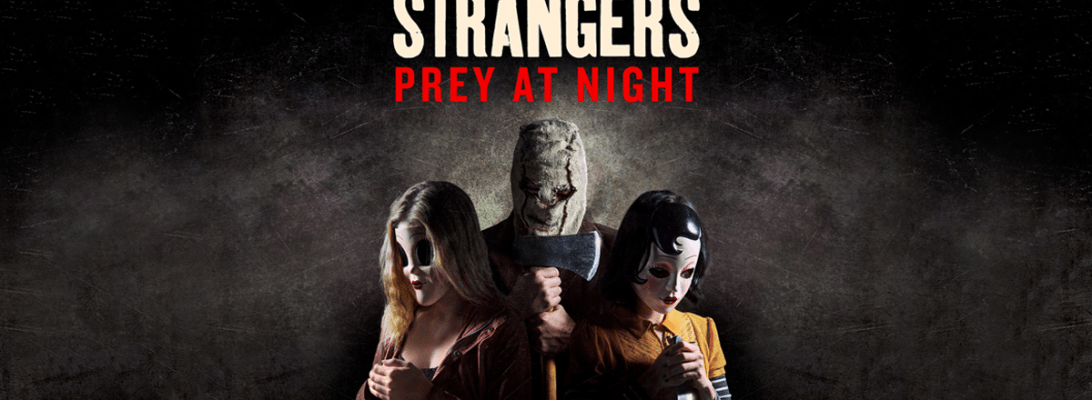
The unnecessary sequel

The-Strangers-Prey-at-Night-for-Blog


Major, major spoilers below.

It is rare that you will find me with a whole day to lounge on the couch with nothing to do, rare indeed. But, when it does happen, I will gladly watch crap film after crap film for as long as I can stay awake. This was exactly how my one day off a week was spent this last week. Sometimes, you’ve really got to listen to your body and sit still, damnit! So, with that being said, one of the movies I watched was the newish sequel to The Strangers which is by far one of my favorite horror films of all time. I rank it up there with Cabin in the Woods and the original Jeepers Creepers. That being said, part two was TERRIBLE.

The Strangers came out in 2008 at the height of the midnight premier craze. I distinctly remember driving home to my brand new student apartment after watching the movie. None of my roommates had moved in yet so I had this giant apartment to myself. It was really creepy! Now, this apartment was in a gated community, not in the middle of nowhere, and not on the ground floor. All of these things added up to mean that I was probably Not going to be the Strangers next victim. What the movie had done so well was keep everyone in the incredibly small cast in the same small area for the whole movie. There was no escape. And in the end, knowing that there was no way to ever identify these killers. Was this a real crime? Could the killer still be out there committing these atrocities?

The open-ended ending was perfect. We see them drive away but we don’t know if they keep on killing, if this was their first, and on and on ad infinitum. Their identities were never revealed and they remain at large which makes the conclusion perfect. It leaves you wondering but not necessarily wanting more.

What is most eerie about the stranger’s taunting of Liv Tyler and Scott Speedman in the original is that they are slow and in control. This is evident even in the way the scenes are shot, never too wide, there is always a bit of a cramped feeling – like there is no escape. Even when they are outside and running between the main house and the barn there are not too many wide shots. Additionally, they never feel unattainably unkillable, just like they have a better handle on things. They were planning mayhem after all and Tyler and Speedman’s characters were just looking to get some sleep after an emotionally taxing day. There were three of them, so the fact that one would knock on the door and another would be in the back is a totally plausible course for their actions. But they were timed realistically and never did anyone receive an incapacitating injury and then get up and further persist in their killing. Slow and deliberate.

Now, take all of that mastery of action (both in the writing and the way it was shot) and throw all of it out the window.

In the latest iteration The Strangers: Prey at Night we are taken to another remote location, this time with a family instead of a couple. Christina Hendrix and Martin Henderson play mom and dad respectively and Bailee Maddison and Lewis Pullman are the children. All of them have a pretty good chemistry and the dialogue seems natural, especially between Hendrix and Henderson. But that is where my praise ends.

The scripts were written by Bryan Bertino in both cases so I’m not sure where things start going wrong.

In Prey at Night the scene is set at an abandoned for the offseason trailer park. We begin by seeing the strangers’ killings in this park, more of what seems to be their at random killing. It is only after we gain a bit more insight that we realize that while these killings were occurring, Hendrix’s character calls and leaves a voicemail for a now dead family member, alerting the strangers of their imminent arrival.

WE’RE HERE! READY TO BE KILLED!

So, one of the aspects of the original is that we know there is going to be death, we see it in the opening of the movie, but there is not an actual murder scene until the very end. This slow build is what makes classics like Halloween so great, the building energy and anxiety felt by the audience inspired by small almost gotcha moments and chilling music. With PaN we get murder right out the gate so now we know the family is driving to their deaths.

A knock on the door of the trailer they check into prompts a question we are all familiar with, “Is Tamara home?” Nope! Bye! The porch light is unscrewed so we have the same, in the shadows, effect as in the original. Of course, after this creepy encounter, we still have the EVERYONE IN THE FAMILY thinking it is a good idea to split up. NO! STOP!

So as everyone begins traipsing across this giant trailer park, the four family members come to realize there are three masked people after them (Man in Mask, Pin-Up Girl, and Dollface). Maybe splitting up wasn’t great after all. As they all run around, the camera is consistently at a wide angle showing one of the strangers in pursuit of one of the family. This takes away the intimate feeling of them being right there and able to “getcha” as was the feeling throughout the whole entire original.

There is one exception to this when Maddison’s character dives into a tunnel on a playground in which there is a scene framed to misdirect you: Man in Mask has headlights pointed into the tunnel and out of nowhere Pin-Up appears and provides a pretty good jumpscare.

However, this leads me to my very next point. Up until the end of this scene, the chase had been between just the two of them [Man and Maddison] and then Pin-Up just appears out of the other end of the tunnel. The reason this is so irritating is that you have seven characters running willy-nilly through this park: hiding, seeking, double-digit numbers of trailers to choose from, playground, woods, clubhouse all of these different places and yet everyone is always one corner away.

IT’S IMPLAUSIBLE AND IRRITATING!!!!

At least twice, if not more, there are chase scenes that just don’t make sense because there is a queer ability of the strangers to just be there. Up until the very end when there is a car crash and a fireball engulfs both vehicles. It’s not just One shotgun shot you need to kill them, it’s Two! There becomes an unnatural persistence that by the end is just like, reaally?!

In the original movie you knew the strangers were there, hiding just out of sight. In this movie they literally pop into sight so quickly you don’t have time to breathe. The films have the exact same run times yet the pace of each of them is totally opposite. You’ve got a slow and steady demise of the main characters, stuck in one house with no escape…and then you’ve got a round-em-up chase story that doesn’t really match with the M.O. of the first.

Bertino has said that he wondered what it had been like inside the house for the Tate’s while the Manson family was murdering them. What was the victim experience as opposed to a cop piecing it together, getting it straight from the encounter? Now, just those two sentences have your mind wandering, don’t they? That is what the original feels like. Clausterphobic. No escape. No nice ending…you know the ending from go. Death. So final that we see the strangers from behind as they take their masks off and you know for certain that the end is nigh. However, one final wrongness of Prey at Night is the taking off of the masks and the way that those scenes play out.

I really hope there is not another movie in this series.

I’m done ranting now.
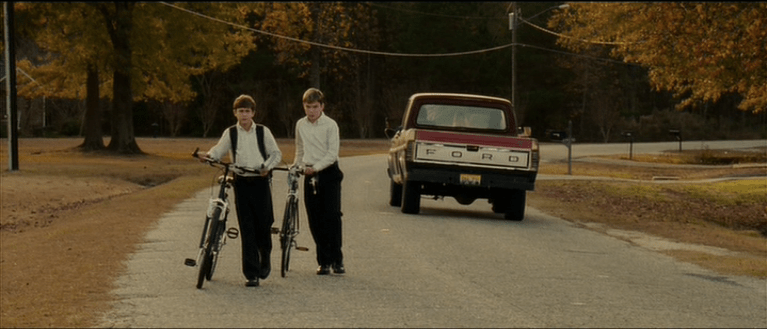
 

StrangersTruck


.

Annihilation

annihilation

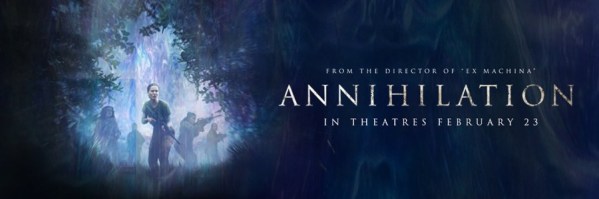
To annihilate something is to obliterate it; to cause something to cease existing. Such a finite word, such a fine word, don’t you think? The complete destruction of a thing. There is a menacing beauty in the complete erasure of a noun. This menacing beauty is captured in the enchanting work of Alex Garland (Ex Machina) in the newly released Annihilation. Adapted from the book of the same name, Annihilation is told to us in a disorienting non linear fashion. Lena’s husband has been gone for a year, Lena is in a clean room being interrogated and unable to remember things clearly, Lena explores a secret zone of national park that has been closed down due to the effects of a meteor. There is much that Lena (Natalie Portman) doesn’t know and the switching between time lines non chronologically makes for a perplexity on par with subject matter that is the cause for everything in Annihilation. The way that this movie and everything in it is shot makes for a dazzling and terrifying and smart film.

The dazzling:

The Shimmer is a biosphere like dome that is slowly expanding and enveloping the lands around a lighthouse which was hit by a meteor. The teams that go in to the Shimmer don’t return so no one has been able to gauge what goes on inside. We journey with an all female team of scientists to see what is on the other side. Three years have transpired since the initial impact and in that time the life inside the Shimmer has had time to grow and thrive in a beautifully alien way. Every shot of the environment inside somehow contains a rainbow whether in light or in flora and fauna. The scenery is at times scary and yet beautiful at the same time. There is a scene in a drained swimming pool that shows death and life intertwined so organically and you sit there thinking about how breathtaking what you are looking at is…and then you remind yourself what you are looking at…and its terrifying.

The terrifying:

The amount of times I realized that I was holding my breath was pretty high by the end of this film. “The monster” is so thoroughly portrayed and yet still unable to be understood. Crocodiles, bears, each other, and on and on…the tricks that this film play on your mind are never ending. One thing that I loved was that you would start to feel comfortable as an audience member, thinking that there was a definite genre path that a scene was taking and then all of a sudden something totally different would happen (again with the disorienting) and you would be left speechless or scared. Garland does not over explain Anything. This is one of the most well paced part one films that I feel like I’ve seen in a while. By the end we are left with as many questions as we had in the beginning, if not more. The enigma that is the Shimmer is so appropriately otherworldly and as we are taken deeper and deeper in we see an endless amount of possibilities that revolve around the very make up of life on Earth. Biology and DNA are used to explain terrifying sights, psychology is used to explain the terrifying behavior of humans under extreme circumstances, nature is used to show us how terrifying our lack of understanding is. All of these elements combined with the twisty turny track of the film are able to terrify while giving us a story that is so smart.

The smart:

As mentioned above, the pacing of this movie and the amount of information we are given is phenomenal. There was not a lot of clunky exposition and at times you just have to accept that there are some things you might not know. In my head throughout the film I kept thinking things like, “ya but what about…x…” and then the story would be moving on and you would just have to wonder about it. I think that that adds fuel to the terrifying aspect to the film too. In addition to the plot of the story, the way in which Garland directs and shows us the story is so thoughtful. There is a scene that is shot with the visual focus on the other side of a water glass. The image is distorted by the water. Tiny things like this are peppered throughout the whole of Annihilation tying in the theme of disorientation in every way possible. But what is good writing and amazing visuals without a great cast rounding things out? The expedition team that we follow is made of five women who are strong and smart and not led by any men. While the number of characters in the film as a whole is pretty small, only like three of them are men. The women carry and lead this film in a wonderfully strong way. They are smart and refreshing and pass the Bechdel test with flying colors.

There is so much more I want to say about Annihilation however I don’t know how to go further without giving any major spoilers and this is a film that really needs to be seen and not spoiled. I’ve heard that the book is pretty different from the film. I’ve definitely added the trilogy to my reading list (you can read more about the Southern Reach Trilogy here). Do yourself a favor: see this movie.

World building whimsy

The best part of getting lost in a world (be it through a book or a film) is that anything can happen. Certain storytellers have the ability to submerge their audience in world’s that can be very similar to ours or very, very different. It is not just that full characters are created or that the story line is well thought out and planned, it is that every aspect of the world is notably considered and taken into accordance within the story’s unfolding. A writer who is able to convey the mores of a culture which they’ve created or enhanced without shoving it down your throat via clunky exposition is a talented one indeed. This is most evident of series in that there is so much more time for customs to be laid out and histories to be relayed. Tolkien took up volumes with the detailed history of a whole land as did Paolini. Lewis built his world volume by volume which allowed for a slow expansion and understanding of the world in which Narnia existed. I think this is why The Magician’s Nephew has always been my favorite. This world building is something that I am noticing more and more as I tear through the Game of Thrones saga (I’m currently in book three) and also something I noticed recently while watching the latest installment of Disney’s Pirates of the Caribbean films. I realize I may lose some of you there. What?! The Pirates movies are being thought of in the same breath as GoT?! Hear me out, lovelies.

When considering a fully realized world, we are able to recognize geography and history yes but there is something else that is also important. The rules of the reality of this alternate-verse are very important to establish so that the author knows what is and isn’t possible and so does the viewer/reader. Rules within a world establish these parameters so that characters experience events with logical outcomes, so that there is a reason when crazy events happen, and so on. What got me thinking about the importance of this was watching the latest (and hopefully last (although through my research I see it won’t be the last)) installment of the Pirates movies.

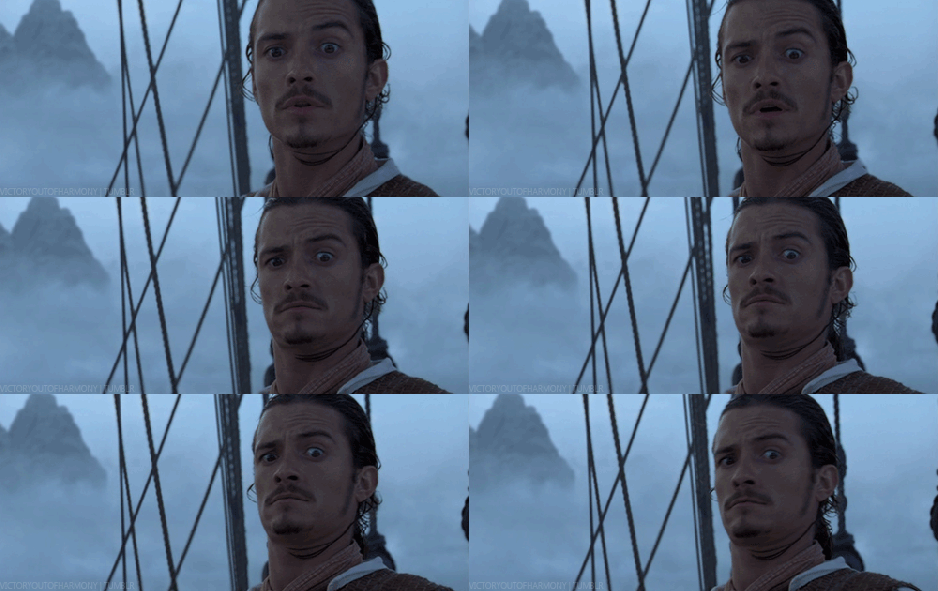
Over the course of the five films that make up this series there are many things that happen that in our reality would not be possible. From the very beginning of the first movie we are let known that curses and magic are real. This is evident even from the title: The Curse of the Black Pearl. Thus begins our education into this world. We are taken in to a time that existed (early to mid 1700’s) and a place that is real (the Caribbean) however the reality is altered from ours. Having Will Turner (Orlando Bloom) as our primary guide through the events of the first film, we learn as he does about the lives of pirates. To start, Turner is pretty landlocked in his life and does not know much about pirate culture. It is only once his love Elizabeth Swann (Kierra Knightly) is abducted by pirates does he get pulled in to the mysteries of the sea. We see with Will that curses are not to be trifled with and that they are indeed very real. Once out at sea, we learn that most of the terrifying tales told by sailors have some sort of basis in the sea’s reality. Monstrous creatures of lore like the Kraken do exist and the boogiemen of your dreams like Davy Jones are real and perfectly able to getcha! As we adventure along with Turner and Jack Sparrow (Johnny Depp) we almost become used to the fact that, yeah, of course they’re encountering monsters. Because of this I feel we almost become jaded in a sense through to the latest installment in which our leading lady Carina Smyth (Kaya Scodelario) is thrust into the mystical world that revolves around Jack Sparrow. There is a point when Carina finally sees something supernatural. She screams and runs out of the water and up the shore shouting that ghosts are real. An appropriate reaction, honestly.

This moment is what really got me paying attention to the world within these films. Because of this moment I realized how prevalent these mystical adventures are in the lives of our leading men and I realized something else too: they all take place far out at sea. We are along for the ride with these men seeing pirate royalty convene for a summit; witnessing undead men, monkeys, and sharks; boarding ships that have been sunk for hundreds of years. These things are very real in this world however there is a whole population who is unawares of their existence. This is a part of the rules of this world. Creatures whose presence cannot be explained shock those who are not used to them (which is again, appropriate). Even when a character becomes used to these things and is part of the pirate life there are still instances where one of them will see something and have wtf moment.

Pirates image

Another saga that I am currently immersed in is that of A Song of Ice and Fire. With five books published and seven total promised, George R. R. Martin has created a whole universe with its own precedence and standards. The history of Westeros and the surrounding lands extends for thousands of years and with one continent and many island countries, the make up of these lands is vast. In fact, there is so much history to cover that in addition to the primary novels that make up the saga ASoIaF, there are also several novellas that give us further knowledge of different times within this world that we come to know so well. Because there are many houses and each of them have their own pasts (in  addition to a global history of wars and times of peace) there is an endless amount of possibilities for characters we already know and for those whom we have not met. But again, it is not the characters that make the rules of the world.

Much like our world and that of the world in Pirates, there are laws of reality that must be followed. Due to the fact that there are many different cultures that we are encountering, there are several different realms in which people exist. Those who live in the far North have very different lives than those who live in the far South and very different again from those who are Dothraki or Lyseni. While there are many different realms there still is only one reality within which everyone operates. It is established within the prologue of the very first book that otherworldly magic exists but is not wholly understood by persons at large.

Something interesting that Martin has done in this land is to establish that there are old gods, ancient myths that revolve around the First Men; new gods, known as the seven; and a Lord of Light, who is very mysterious [and seems somewhat cultish]. I find this compelling as it is a small similarity to our own world in which many different religions and schools of thought exist. Because of this, we are able to see very quickly that the many different regions of this land operate under different beliefs. Most often the new gods are mentioned. Those who worship in this manner visit the Sept to pray to one god who is represented by seven faces seen as the Mother, Maiden, Warrior, Father, Crone, Stranger, and Smith. Each of these are prayed to for different reasons: to keep a son safe in battle, to keep a woman safe during childbirth, etc. Then there are the old gods, worshiped in the North by the first men and by some who live still. There is a magic in this belief; a connectivity to the forest and all its creatures. The wierwood trees in the forests and in the godswoods of castles and forts create a conduit of sorts for these gods to see through and be prayed to. Lastly, there is the Lord of Light, who is said to show his true believers the way if they stare into the flames of fires. The character Melisandre is who [largely] leads us through our knowledge of this particular religion and because it is not widely known or practiced in Westeros, many men distrust this vein of thought and see it as witchcraft. That last bit is interesting. The fact that the Lord of Light’s followers are mistrusted because of their “devil worship” or “sorcery” draws attention to the fact that magic is not something that is trusted in this land. The gods of old seemed to posses some magic but their times are long gone and there doesn’t seem to be any magic left in the world. That is, until dragons are born and a crippled boy becomes the keeper of knowledge past and present.

Aside from religion, there are other aspects of the world of Westeros that are outlined to establish the world. In battle, men die (whereas as pointed out above in the Pirates world, ghosts exist). There is a hierarchy that exists by which the land is governed. Despite the fact that there is a very large scale war going on for the Iron Throne, there is a system in place: lords, wardens, etc. Culture is explored through songs sung by bards and tales told around the campfire. It is fascinating to me how deep and rich the history of this land is.

GoT image

Getting lost in a world that is not our own is part of what makes reading and watching movies so compelling. We are able to escape our lives for a span of pages/the run time of a film and truly be somewhere else. The greatest storytellers create fully realized settings to further allow for this escape and totally submerse their audiences. While it might be easy to create a tale, coming up with the entire world is what makes the escape successful. Whether it is building the world from scratch (example: Lord of the Rings) or slightly altering our reality to make it their own (example: Inception), an author who takes the time to think out all aspects of their world is a skilled one indeed.

Penny Dreadful – Showtime

published penny dreadfuls

Gothic literature is a beautiful thing. So easily identifiable and so filled with hidden meanings, psychological and supernatural intrigue, and lessons to be learned. My undergraduate degree is in English Literature and I took more than one class on specifically Gothic Lit. My most frequently recalled example of the genre is The Yellow Wallpaper published in 1892 by Charlotte Perkins Gilman. Not only is the story itself a trip but it is also a work published by an American, proving that the genre is not solely ruled by the Europeans. Gothic literature has a rich history that spread across many countries in the mid to late 1800’s. Classic conventions of the genre include horror/supernatural elements, death, and the macabre. It often times includes a female protagonist who is dealing with some sort of psychological disorder. Many female writers of the time used the genre to have their voices and perspectives heard on issues that would otherwise be swept under the rug. There is typically a setting in these stories that takes on more characteristics than just a normal scene. Embodying histories and feelings and usually certain architectural elements, these settings become as much characters as the people within the stories. The literary scene in the 1800’s was booming with tales of the supernatural. From Mary Shelly’s Frankenstein (1818) to Bram Stoker’s Dracula (1897), and Oscar Wilde’s The Picture of Dorian Grey (1890) there was no need to look far for tales of monsters who walk among us. In these times, printing and publishing were very expensive and so stories were often serialized and published in magazines on a weekly or monthly basis. The stories would be eagerly anticipated and provide a brief escape from the world around them. In addition to these works, there were also shorter works published for pennies and made available to even the poorest of the poor. These penny works became known as penny dreadfuls for the gruesome and dreadful tales depicted within. Beginning in the 1830’s, penny dreadful tales included reprintings of classic Gothic literature such as The Castle of Otranto as well as new pieces of horror like Sweeny Todd: The Demon Barber of Fleet Street. 

Fast forward to the new millennium and people are still enraptured by tales with these dark and classic elements. Enter Showtime with their series Penny Dreadful. For three seasons we are taken through a classic Gothic tale all the while pulling in more and more of the characters that were made so famous in the 19th century.

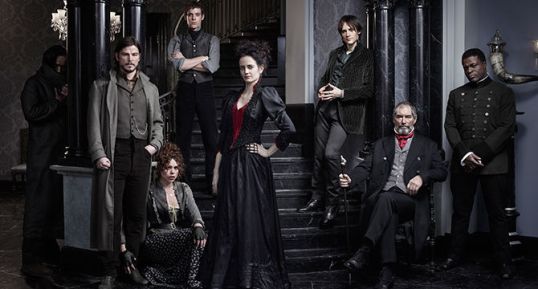
Penny Dreadful cast

While this tale is being spun, we are introduced to Ethan Chandler (Josh Harnett), Ser Malcolm Murray (Timothy Dalton), and Vanessa Ives (Eva Green) as our three main characters. While these people individually are not part of the established canons of the tales from which the show draws, they make up the central ring of the spider’s web. Malcolm Murray’s daughter was Mina, a name that should sound more familiar to you. Mina has been missing for some time now and Vanessa, in the first season, begins getting these visions and feelings that Mina is trying to reach out to her. Thus begins the supernatural quest in this Gothic tale. Ethan Chandler becomes their gun for hire as Ser Malcolm and Vanessa begin to explore what is happening to Vanessa. Together, the three of them delve deep into psychic connections, seances, and the biggest quagmire of them all: the fight between good and evil. As our guides become more entrenched in this world, it is clear that they will be unable to unearth truth and answers by themselves. When Vanessa becomes fully possessed and in need of medical attention, the good doctor is called for. Enter Dr. Frankenstein (Harry Treadway). As the realization of other worldliness enters, so does the famous hunter Van Helsing (David Warner). The spider’s web broadens and so too does our scope of the supernatural in London. Between demonic fits, Vanessa is a part of high-ish society in London and one of her social circles brings her close to a beautiful and charming man. Dorian Grey (Reeve Carney) does not get much interaction with the other characters in the beginning aside from Vanessa however in the latter part of the series his immortality is matched by that of another character’s and the tragedy that unfolds in that story line is heart wrenching.

Witches appear, a wolf man is present, and a darkness is descending on London.

The ability of the writers to bring all of these characters from different Londons into the same time and place is really well done. With three seasons to complete their tale, the overarching plot is well paced and there are not really any loose ends by the time it wraps. What I loved most by the end is that you as the viewer are so clearly able to see that this is a tale of tragedy for everyone involved. There is love and there is death and everything that comes between. Part of what makes the tales of love so great is that they are not all strictly between one man and one woman as a conventional love story might portray. For example, Vanessa is not related by blood to Ser Malcolm however he loves her like a daughter and is supremely concerned with her well-being. Dr. Frankenstein shows a deeply reckless and morbid sense of love for his creations (of which there are ultimately three). His love is not responsible or ethical yet it is deep and honest and earnest. Frankenstein’s moral journey through the three seasons plays out without the knowledge of the three main characters and so his evolution is largely just between him and his creations. Vanessa’s love for and belief in Christ is a very important thread in this web as it allows for the entry point into our story of the war between God and the Devil. Dorian Grey’s love for himself and all things beautiful brings into the story questions of being comfortable with and loving yourself. He is alone even when in the midst of a crowd and there is a woman who enters who helps him relearn this lesson and realize the importance of self. Lily (Billie Piper), the woman I just mentioned, is an amazing and breath taking character. Her strength and will inspire women around her, who she draws in like the spider I keep referencing. She comes to us in season one as a whore, lowly and taken advantage of, and by the time she is reborn and brought back in to the world with a strike of lightening, you are able to see the layers and layers of trauma that haunted her in her past and shape who she is in the present.

Then there is death. Lots of it. Dracula, the Wolf Man, Frankenstein’s monsters, they are all in the city at the same time and woe is the human who gets in their way. The vampire feels no remorse for his kills. He is above humans and views them as pawns and food. However, the other two monsters I mention are creatures with deep awareness of and remorse for the kills they chalk up. One of them is unaware of his monster as the wolf takes over the human, blotting out the humanity which guides the man and letting in the animal instincts which make him a wolf. As we get deeper into the lore and backstory of the wolf and how he came to be, elements of American Indian histories are included and explained. This to me was very interesting as it was such a sharp deviation from the Victorian lore that had been the backbone of the story thus far. Frankenstein’s monster (Rory Kinnear) names himself John Clare after the poet and is a beautiful soul of a soulless creature. His journey is largely apart from the main tale as Dorian Grey’s is. We know nothing at the start of his tale of this man’s past. Who he was and how he had died is as much a mystery to us as it is to him. John Clare does some killing of his own out of rage and necessity of certain situations. Through his rage he learns that this ability to “turn in to a monster” really scares him. He looks enough the part, he doesn’t want to play it too. Deep down, he is a gentle soul who likes to read and loves poetry. We are able to see the hurt he feels when people are scared of him, the pain he feels when someone reels at the sight of his face. He is a walking tragedy in and of himself.

Penny Dreadful is one of those shows that seemed aware of it’s time frame and conscious of the arcs of each character. Thus, the story is a complete one with a defined beginning, middle, and end. A beautiful tale which breaks down how well we know ourselves, how we care for those around us, and how events in our lives effect those around us. Vanessa Ives’s awareness of everyone in this universe (she is the only character who has verbal interactions with every single other character) is a way for us all to see the chain reactions our actions have on those around us; she is the female protagonist with the psychological issues after all. The light and dark pull felt throughout the show is a constant reminder of the forces of good and evil at work within us all. Additionally, there are metaphors out the wazoo in this series, such as many scenes being shot in mirrors, the allusions to spirit animals, and the divine at work through humans. All of these elements make it a very successful telling of many Gothics we are already familiar with. What an amazing show, you guys. A definite must watch.

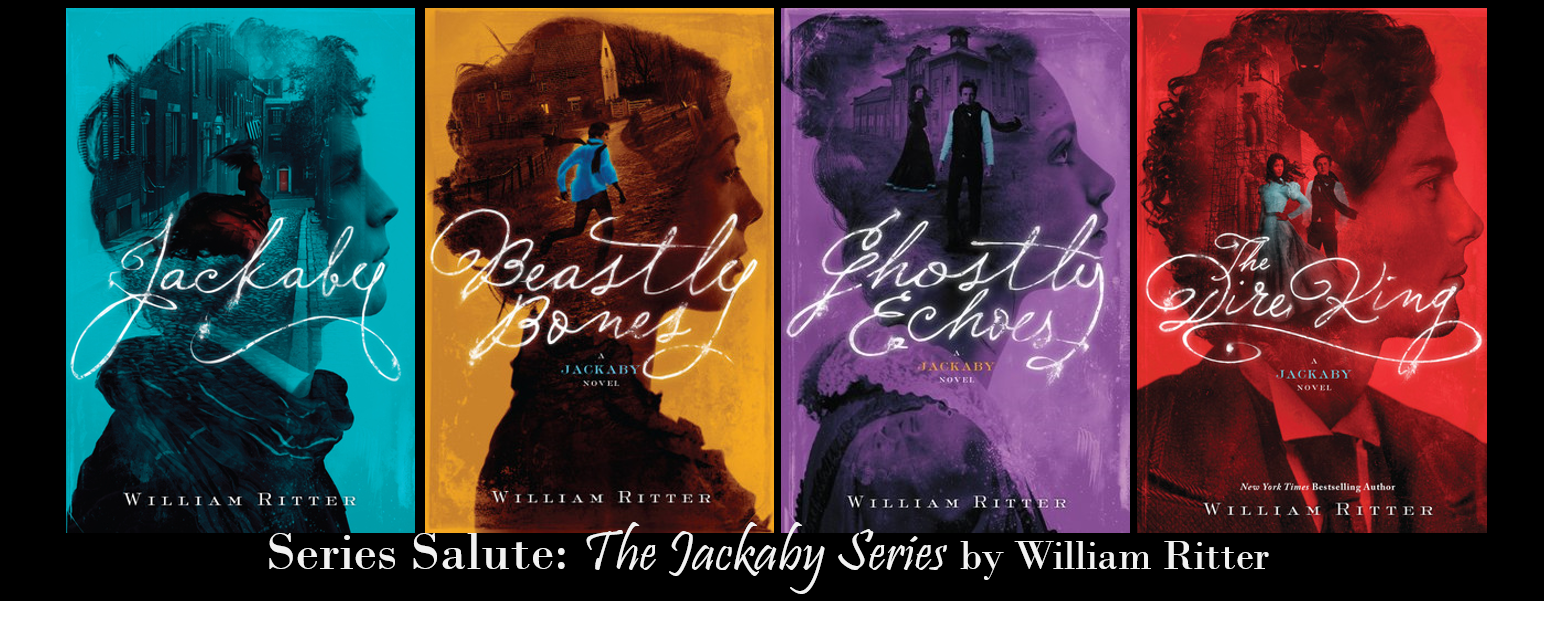
The Jackaby novels by William Ritter

** Tiny bits of spoilers lie beneath this sentence. **

There are times, lovelies, when a series seems harmless, there are times when a title sits on your shelves for months maybe even years and you give no second thought to it. There are times when you finally pick up one of those books and it is just as boring and uninteresting as you had thought. As avid readers, we get used to the spines on our shelves and whether we have read them or not, they are our trophies, our scores and finds, our prizes. Then there are other times, where you finally crack one of those spines and it sucks you in like spell has been cast. You are able to think of nothing but the characters and their adventures and when you do not have it open in front of you the book is still on your mind and in your head calling out to be reopened and dived into once more. The Jackaby novels are very very much the latter of those scenarios. I don’t think there are enough positive words in the English language for me to gush enough about how much I loved this four part series. But, for your benefit, I will try.

Abigail Rook (mentioned in the previous post regarding female leads) is our narrator over the course of these tales. As the series opens she is fresh off the boat from a failed paleontology dig and is in look of a fresh start – immediately establishing her as an adventerous woman. One of the first people she meets in New Fiddleham is Jackaby himself although it is not until a few chapters later that we are properly introduced to him. By the time he officially hires Ms. Rook to be his assistant we have already visited a crime scene with him and seen that Abigail is not as prim and proper as many other ladies of the time. She is incredibly observant and determined and as readers we get the sense very quickly that she is going to be a good and reliable narrator. R.F. Jackaby is a paranormal investigator and the world’s current Seer. It is his duty to use his Sight to keep the peace between [mostly] oblivious humans and the magical beings who secretly populate our world and exist among us. He has been at it for about 20 years and has made quite a name and life for himself in New Fidddleham. His offices and housing (as well as Abigail’s once she is hired) are in the house of a deceased woman named Jenny Cavanaugh. Jenny still presides in the house as the resident ghost and her emotional journey is really amazing. (More on that point in a bit.) These are our three main characters and their relationships to each other and with the magical community at large become central to the story…or is the story central to them?

One of the things that I think Ritter does so well in this work is that the overarching plot from start to finish is so cohesive. It is bananas! Something so simple and well structured makes the storytelling so amazing. As readers we first get hints of this larger thread that connects everything in book two. We are able to see that the events in book one weren’t the beginning and that strings have been being pulled puppet style for years. This type of tight knit, no lose ends story telling is refreshing in it’s simplicity (as I’ve already mentioned and will probably mention again). There are red herrings and twists and turns and if you really pay attention it is easily figured out but that is not the point. The point is that Ritter takes this tale as old as time of good and evil of us versus them and gives it a positive female perspective and makes it engaging for young readers. So far, all of these books (with the exception of 4 because it is brand new) have topped Year’s End lists and have been super positively received.

While there are many supernatural points in these stories, there are also parallels for very real issues. Many of our other worldly characters have glamours on themselves so that they appear human to the untrained eye. One character who does not have to do this is Charlie Cane/Barker as he is able to transform at will from a human to a (not naming his creature as it is a spoiler). While this ability allows him to lead a fairly undetected life, events in book one make it necessary for him to reveal his true self during which time townspeople see him and demonize him. The hatred and fear exhibited towards Charlie is only a prelude to the racial prejudice that many of the townspeople have once they find out there are many more fantastical beings among them. In a scene in book four, all of the jail cells are full of creatures who have done nothing wrong except not being human. There is no way to not draw a parallel to the segregation of our races here in America and the fear that many have of people and things who are different and unknown. What Jackaby shows us is that there is nothing inherently wrong with you for being different, we are all just who we are.

Another character who helps us see that it is okay to be who you are is Miss Lydia Lee. While Ritter never goes into explicit detail regarding labels, we are let known that Lydia Lee is a man who likes to dress as a woman. When we first meet her, she is being attacked physically and verbally by men who do not understand her; who are uncomfortable with her decision to live her life the way she has decided. What I thought was particularly amazing about this is that these stories take place in the early 1890s and I don’t feel like, when you go that far back in a setting, you see anyone represented who isn’t white and straight or black and a slave. The fact that Ritter takes the time to make it clear that Lydia is who she wants to be whether anyone else likes or understands it is really wonderful.

Lastly, as mentioned above, Jenny is another example of a larger metaphor. Jenny was murdered and her death plays largely in to the grand scheme of things once it becomes clear that so many “huh that was weird” occurrences start becoming connected. While Jackaby has tried many times over the years to help Jenny solve her murder and move on to the afterlife, a big issue in preventing this closure is that Jenny seems unable to leave the house. She is able to exist within the walls and is able to touch things/items that belonged to her in life but that is the extent of her physical capabilities. Once Abigail comes along, she and Jenny really get to work trying to help Jenny get out of this cycle of disappearing any time she tries to leave the house or dropping objects that aren’t or weren’t hers. This behavior seemed to me to be a metaphor for depression and a bit of agoraphobia. With the help and patience of Abigail she is able to overcome this. However, it is not an easy task and is by no means minimized or dismissed. Her peers are encouraging and inclusive even when Jenny is down on herself. This is super important and really compelling.

While these themes and metaphors are very important, something that is even more central is the building that Ritter does throughout both in terms of the world and it’s characters. We start with knowing as little about the world as Abigail does and through her eyes and Jackaby’s tutelage we gain perspective and become woke to the intricacies and magic surrounding us in every day life. We start off naive and unaware and become entranced and enlightened. There are histories alluded to and stories that exist in this world however it never feels like we are being preached to or talked at. Due to his insight Jackaby provides us with information on the world that Abigail might not have come by on her own. We are, at times, taken out of new Fiddleham and the into other communities (both of this world and the next) that are connected to the story, we are taken back in time in memories of characters. These flashbacks (and I hesitate to call them that as they are not cheesy exposition but well done exposition) provide an expansion not only of the world but of how each of these people fit in to it. Motivation is shown, not just action. By mid way through book one I was already longing to be  Abigail and Jenny’s best friend and to be part of Jackaby’s team. These are fully realized people with hopes and dreams and I that is not an easy thing to do nor is it always achieved by writers (especially so quickly).

I think the last time I got this sucked in to a series and devoured it as quickly was two Christmases ago when my partner introduced me to Susan Collin’s The Underland Chronicles. These four books (Jackaby, Beastly Bones, Ghostly Echoes, and The Dire King) are impeccably written and really smart. As Jackaby says, “I have never found a book that did not have at least a little magic in it…They can’t help it.” If you are on the prowl for your next obsession, look no further!


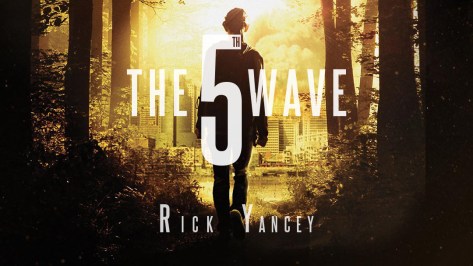
The 5th Wave – Rick Yancey

the5thwavebook


Well wasn’t May just a kick in the pants, lovelies?! Life was hectic in general but to top things off I was bookless for almost the whole month. I think I started like four or five different books. These are books that I will eventually read (…she tells herself) but I needed something with a hook. I needed a tale that captured me from go. You know, that feeling that you get when you open a book and 10 seconds later you’re 60 pages in? That book that calls to you when you’re not reading it…The 5th Wave did that to me. Rick Yancey does an amazing job weaving the overtaking of our planet. This book is horrifically terrifying. For example, are you currently not really a fan of birds? Do you think that angry children are actually super dangerous tiny humans? If you have fears like these, this book might be too much for you. But you should read it anyways because it is. That. Good.

Cassie Sullivan is our primary storyteller through whom we learn about the beginning of the end of the world. There have been four waves so far. First, all of the electricity went out. Second, massive earthquakes and tidal waves cause flooding of every coastline in the world. By this time three billion are dead. Next is a plague transmitted by birds that wipes out 97% percent of the population. As we walk through this world with Cassie, alone and terrified, we learn with her about what comes next in the invasion. It is, at this point still hard to imagine the magnitude of this end of days situation. As Yancey says in the book, a “single death is a tragedy; a million is a statistic.” The scope of this book narrows in and then zooms out again. So, many times, are you reading and just going through the pages and then you stop and reread a sentence and realize how truly horrible some of the things going on in this book are!

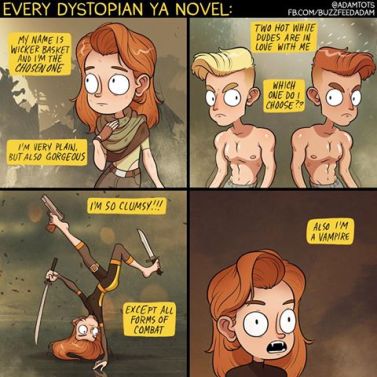
There are other strands of narration as well which add to the awareness of the horror. We get in the mind of an alien sniper, who wades through the aftermath killing any human he comes across; additionally you also have Cassie’s brother, someone she went to high school with, and a person who saves her. One element that creates and holds tension throughout is that They look like us (Obvi.) so even though you might know someone, how do you know you know them? You know what I mean? The whole book is like that!! Yes, if you really think hard you can figure it out as you go. But, if you’re just reading this to get excited about suspense that isn’t your standard Every-Distopian-YA-Novel a la:

YA Comic

then this is for you! I really was invested in each of these perspectives and what’s more, they didn’t spend their whole section/part being worried about “the girl” and not doing their own shit, as it is, ya know, the end of the world and what not. Themes of keeping promises and love being the primary driving force are present, yes. However, I thought they were done in great ways. There were times when I went, “oh come on!” when it was getting a little too formulaic but those issues straightened themselves out fairly quickly.

While we do get to see these other perspectives, I really appreciated getting to know Cassie’s voice. When we are first introduced to her she is on her own after her brother has been taken by uniformed men and her parents die during two different waves. She is trying to survive in a world in which, as far as she knows, she is the only one left alive. She is strong and focused after not having seen another person in weeks…or is it months? This uncertainty of time is something that Yancey plays around with very beautifully. Characters often think of time in relation to their actions and the happenings around them, seconds into eons when a bullet is speeding towards you, hours into years when you’re left alone in the dark. When you’re solo in the world, things can get screwy. The noticings about time are interesting in the end when you realize the grand scale of these aliens coming from who knows where and how far away…how long has this been in the works? And we as humans can only think in the smallest increments of time.

In addition to the time talk, there is often weighty, lofty things that only get said in books and movies that are somehow just on this side of okay. For example,

“Cassie Sullivan didn’t run…He could see the familiar look of fear in her eyes, a look he had seen a hundred times, the look we give back to death when death looks at us. “

Is quickly followed by,

“His heart, the war.

Her face, the battlefield.”

But it is all okay! I’m fine with goofy lines if the story is strong and the people have good solid reasons to be on these “missions” that they are invariably always on.

The gravitas of what these kids go through – because they are all kids – is disturbing. Imagine all of the adults in the world dying and the kids being taken in by some sort of military unit and being trained to hunt. They don’t know if they are being told the truth (and neither do you), nor are they old enough to really question things. Over the course of the fourth wave, you again realize what is going on and have to occasionally re-read paragraphs. Whether they are made to do these things by humans or Others, going through dead bodies and “processing” thousands for cremation is not something that should be on an eight year old’s to do list. Neither, for that matter, should weapons training and emergency medical/tactical care be subjects that should be taught to six year olds. You realize that these children, who are now parentless, are being guided by people who are not at all concerned for their well being or what is best for them. They are being trained brainwashed to kill. These horrors of the day keep tolling up and these kids are so glad to no longer be on their own in the middle of an alien invasion that they believe everything they are told!

Over the course of the entire book, you think for a section that you have something figured out and then the next chapter can go two ways: you could be wrong or you could be right which is sometimes even more scary. I haven’t read any of Yancey’s other works so I don’t know if he is just always good at suspense but man alive I am glad I fell into this book. There two books which round out the trilogy and I am anxious to start the second. I do know that there is a film that was made on the book in 2016 and I have heard nothing but terrible things about it so I haven’t as much as even seen the trailer. I wanted nothing to taint my experience of the book. This is an action that I am grateful for. There is also a lesson in that: don’t just watch dystopian thrillers. Read them. For an adventure that takes you to the end of the world and frequently punches you in the gut, pick up The 5th Wave.

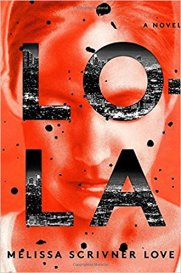
LOLA – Melissa Scrivner Love

LOLA


This week I finished LOLA which came out in March of this year and was written by debut author Melissa Scrivner Love. Over the course of a week and a half we go through an experience with Lola that has the potential to solidify her in a world she leads from the shadows. With a deadline and the threat of death from multiple drug lords, Lola is tested as she emerges as the true leader of LA gang, the Crenshaw Six.

When the book opens, we meet Lola, our narrator and the girlfriend of a man named Garcia who is assumed to be the leader of a gang which controls blocks in the neighborhood of Crenshaw. We are at a back yard BBQ when a messenger from the cartel arrives and wants to speak to Garcia, giving him a mission to interrupt a drug deal between a cartel customer and a rival supplier. Throughout this meeting Lola hovers on the fringe, notting everything the man says and also how he acts and her inner dialogue immediately sheds color on the woman whose psyche we are going to be in for the next couple hundred pages. Short sentences, to the point and very observant.  Whether or not someone’s English has an accent, if they are sweating and nervous, the way the air feels and tastes in the LA heat. It is clear that she is a very reliable narrator…and one who knows a vast amount more than what people expect her to. Within the first few pages, it is clear that Lola is the one running things and no one yet realizes this outside of her five soldiers.

The mission set to the Crenshaw Six, the drug deal from which they are to recoup a name plus both the cash and the loot, goes terribly wrong. And from here we have a chain of events that propel Lola into having to navigate between the cartel and this new drug supplier (who turns out to be rich and white) selling heroin to upper class users. First daunting task set to Lola: find out who this new man is, infiltrate his organization, and find out where his stash is held. Her deadline: one week. Next task: after having infiltrated said organization, Lola must prove her loyalty to the white man for him to trust her. He tells her to kill the man who was the cartel client. The one from the deal. She is again given one week. Throughout all of this, Lola is pretty collected. We see the actions of a calculating leader who’s people trust her and the plans that she comes up with to get them through these situations. It is wonderfully eerie to read passages outlined with her practical business like manner and then to flip the page and have her trying to  do good and create a safe space for a little girl.

In addition to the little girl, Lola also cares for her mother who is a recovering junkie. These two responsibilities illustrate the domestic side of Lola’s life. The balance that is consciously kept between gang leader Lola and dutiful daughter and woman Lola. She narrates about how she uses conceptions of her, often misconceptions, to her advantage. And people constantly underestimate her. I really enjoyed how she trolled these waters looking for her in to the game with the men. Lola’s confidence and level headedness is what I enjoyed most about her and this work, I think. There are a couple of other females that aren’t as flushed out as they could’ve been whose deeper perspectives could’ve been interesting.


The deadline and climax of both missions happens so near the end I thought it was going to be a cliffhanger. That being said, wether she makes it or not, there is room in this world to flush out more stories. I think Love could develop quite a few tales and am interested to see what she does next.

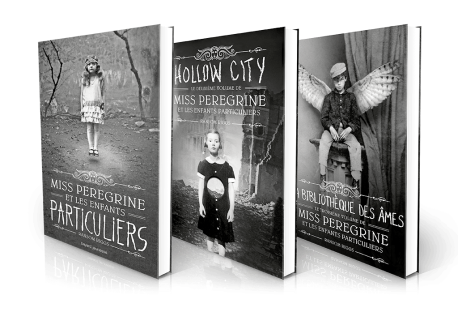
The Peculiar Children series by Ransom Riggs


Miss-Peregrine.png

The first, second, and third novels of Miss Peregrine’s Peculiar Children are very darkly whimsical. Not in a Tim Burton way (I promise lovelies, this is the only time I will mention him) but in a sepia toned, phonograph, crackling edges kind of way; a way that progresses at juuust the right pace. Ransom Riggs brings us into a tale that you have to read to believe.

We begin with the self titled Miss Peregrine’s Home for Peculiar Children and Jacob Portman’s adventure from being a normal to realizing his a peculiar. As Jacob is our narrator we learn things about this new world, its history and its secrets, at the same pace he does. Which is why we are equal parts unsure of his grandfather’s sanity and the possible truth to the far out stories of his past when he dies a tragic death by a creature only Jacob sees. It is this traumatic event that slowly begins the chain of events that will open Jacob’s (and our) mind to untold possibilities and bring us to the time loop(s).  We learn that Jacob’s gramps was a peculiar and so is Jake…they specifically can see these beasts that are ultimately Grandpa Portman’s downfall. Hollowgasts. They haunt peculiardom, eating the souls of any peculiar they can reach and are under the control of wights – the organized baddies. Anyway, peculiars. What are they, you ask? Who are they? Well, they are magnificent humans with the ability to do things like float, or have mouths on the back of their head, or create fire with their hands. I know your next thought: hmmm that sounds a lot like mutants. The thing is, these are all children…on the outside. The aforementioned timeloops are spaces on top of, or maybe behind, reality. They are little pockets that freeze a day and loop it forever; their inhabitants’s souls age however their bodies do not. This is where peculiars have taken to; unable to comfortably live in the open as wights and hollowgasts have hunted them for a century through the centuries. Not only are we introduced to this world in Riggs’s first title, we are also given brief glimpses of a much deeper narrative than just a boy grieving over his grandfather (that sounded dismissive but it is not meant to be) and finding his way back to the grandfather’s childhood home. There is the understanding that something serious is going on in these people’s worlds and we have arrived just in time!!!! (#savior) While the tone of this book is serious it has some moments of light. They are all still children: naive and living in a sunlit snapshot of time and when Jacob joins them he too has a lighter sense of self. As the book comes to a close we are promised that the understanding of and our perception of this time and place are about to be expanded even more. With a cliffhanger that leaves you thinking “Oh no!” there is no choice but to immediately pick up book number two.

Unfortunately it took me a whole year between buying the book and beginning to read it so there was a little remembering that I had to do which is okay because it picks up exactly where book one ended. Hollow City is the tale of Jacob and all of his new friends, Emma, Bronwyn, Enoch (et. al), on a rescue mission which has so many close calls you can’t help but speed through the book at the same breakneck pace. There is so much action and quick paced scenes that your eyes might not be able to keep up with your mind! We go from the sunny island of Cairnholm on which they have all lived for 60 years deeper into the loop to the same day but in London. The adventure of getting there and the people they meet gives us more insight into history and more is steadily revealed about this big bad. The fact that this is taking place during WWII is significant as the wights are able to pose as Nazis and no one thinks differently or realizes it. This allows them to be organized and systematically hunt down the entrances to these loops. They can’t go in, you see, so they employ traitors and trickery to get the peculiars and their guardians the ymbrynes to come out of the loop and get snatched right up. For what, you might ask? Well…that’s a mystery too. A dark and terrifying mystery as no one is ever seen from again and capturing an ymbryne is no easy feat. Over the course of Hollow City we are guided deeper and deeper into this loop and even into a couple of other ones too. The layers of the world that Riggs has created is dizzying at times. However, the addition of layers adds to the tone which has lost its sunshine and has gained an air of anxiety and fear; uncertainty about everything.

Just when you think we are about to have a happily ever after moment to end this rescue mission that has been chalk full of foiled plans and dastardly encounters the plot curves and leaves you gasping, “Well, fuck!”

This sentence is appropriate as it allows me to continue talking about this tone shift. I noticed a difference in Jacob’s words as the journey darkened and he had to grow up a bit and make some really tough decisions. It is in book three, Library of Souls, in which I first notice Jacob swearing. His shift is actually so perceptible in this one that he begins to think of himself as new Jacob and old Jacob. By this point, Jacob and Emma (who is our strong leading lady), have been through so much that they are exhausted and unable to trust anyone. A very old loop and a very shady ferryman usher J and E to Devil’s Acre where all of the outlaws of peculiardom have floated over the centuries. It is here that a steadily increasing amount of our friends are being held captive, abducted over the course of book two. Here we learn the twisted plan of the wights; this is the evil dungeon, the lair. Here we have the culmination of Jacob’s journey with Emma to save his friends. We also have, the final show down of the good vs. evil that has been plaguing these people. A carefully sleuthed plan, a final battle, and a resolution that covers all loose ends and loops. The dirge of Devil’s Acre is so disgusting and makes you squirm and grimace. It is in this horrible place that Jacob truly grasps his gifts and harnesses his ability. However, there are still a couple of chapters after the titanic tussle because life goes on after a battle and lives must be rebuilt. Can they be?

I tried to make these descriptions as vague as possible while staying interesting. I hope I did that. These books have really good twists and are very thoughtful in the telling of history (paradoxically) and an unravelling of what is behind a story. My favorite, I think, is book three as it has a character named Sharon whom I really enjoyed, shows what a community looks like in this horrid place, and reveals that there are so so many sides to a story. The evolution of Jacob Portman is really great to witness. I highly recommend this whole series and also the companion book. Tales of the Peculiar is a tome mentioned several times throughout the series and the printing of the books is comparable to that of Beetle the Bard’s tales. Something that I didn’t touch on at all yet is the fact that these books all include old early photographs of really odd and striking scenes with people who could very well be peculiar. They are all real and have been collected from various estates. This adds to that whimsicalness I mentioned at the top in which everything is just a bit spooky.

In closing, read these tales. Believe in the peculiar and in yourself.

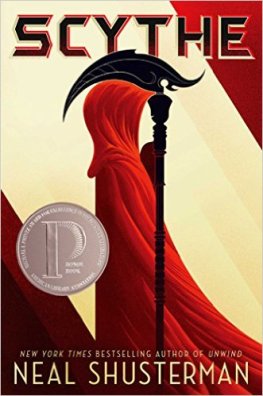
Scythe by Neal Shusterman

Scythe


In a world populated by humans who have conquered mortality, population control must come in some form. Right?

Hello lovelies. I just finished reading Scythe by Neal Shusterman and man alive was it good. A little predictable at times but overall a pretty good read. Humanity exists, ever growing and never dying, in an age where, once you reach your height of outward age, you “turn the corner”. Refreshing yourself body and keeping all of your mental faculties the same. Thus, someone you meet who is 98 might look like they are 25. Over and over again. The age before is known as the Age of Mortality where things like antibiotics were necessary and falling off a building wasn’t sport it was suicide. The characters in the book are far enough removed from this age to find the concept of a headache beyond imagining.

Citra Teranova and Rowan Damisch are our primary threads throughout the course of the novel. However, there is input from Honorable Scythes that separate the chapters, taking the form of journal entries (more on this in a bit). When we open, Honorable Scythe Faraday has separate interactions with both of our hero(in)es. Due to these meetings, both subsequently become apprentices to the scythe. At this point you might be asking what exactly does that mean? Why do I keep repeating that word? Well, scythes are the only people allowed to kill in this reality. Because of the ever growing, never dying population, control must be extolled in some manner, right? Scythes are legally sanctioned to kill and they have quotas to meet (just like all of us in our real jobs! Scythes are just like you and me!) (Except they’re really really not.). Citra and Rowan say good-bye to their families and begin their training in the arts of killing.

One of the things that I like about this tale is that even though these people are not able to die (they call it “splatting” after which they are taken to revival centers which do exactly what’s in their title), they still view life as precious. Taking it permanently gives them reservation. They are not impervious to their consciences. The same cannot be said of all characters. Those peeps are juicy and crazy in equal amounts. Anyway, Rowan and Citra are training under Faraday when some mischief happens and they are sent to be mentored elsewhere. What I haven’t told you is that not all of Scyethdom is happy with the fact that the scythe has taken on more than one apprentice. In fact, it is something that has never been done before. As such, it is determined that they will not both be accepted into the fraternity. One will have to glean the other. These humans have become so detached from societal killings that they are no longer referred to as murder but as being gleaned.

All of this happens pretty quickly in the novel and it is mystery and intrigue and life lessons from then on. The pair are made to part and train with different scythes. What is interesting here is that we see the training style of not just one scythe but three (potentially more…read and find out). These three scythes are the ones who make the journal entries between chapters, mentioned above. This give us a chance to see not just Citra and Rowan’s views of this vocation, new and inexperienced, but also the older generation who have been doing this for many years and have a very different perspective.

What transpires from there in the story is too good to spoil. Just know that these characters, in particular Citra, are very relatable. Readers get to experience so many different thought processes about what it means to be legally authorized to kill. When you think about what they are doing and the fact that they are in their mid-teens on top of that, it really gives you pause. Not only are they teens but they are teens amongst elders centuries old. Society has gotten to the point where the Thunderhead (having graduated from a cloud) is the foremost authority on societal control. There are no more cops because the Thunderhead prevents crime. There is no more government because it was proven they were all too corrupt to lead and the AI could do it better. Countries are now regions, continents grouped in accordance with geography. The world that Shusterman creates has an explanation for all of the ways the world has evolved.

At first I was worried that it wasn’t going to be good and be really predictable. But there are a couple of twists that throw you off course and make you recalibrate how you view this world. For example, the scythes to which Citra and Rowan are transferred both operate very differently not only from Scythe Faraday but also from each other. The moral dilemmas that they face independently turn out to be really fascinating to read through. It is very obvious to me why this book was on so many Best of 2016 lists last year. Pick it up and give it a read. Would you be able to kill for the greater good?