
You know the feeling you have when you leave a Fast and Furious film and the drive home is impossible to make without wanting to race someone? Or the feeling you had after leaving a Spy Kids film and pretending that your watch is really a secret communication device? You come out feeling so part of that world that your imagination just keeps going after the movie is over. Now apply that to the last horror film you saw and take away the sound and it still probably wouldn’t be half as amazing as A Quiet Place. The blinker in my car on the way home unnerved me and as I was sitting at the stop light waiting to turn, I anticipated something darting out of the dark towards me. It was in these few moments when I also realized how tightly I had been clenching my jaw.
John Krasinski has directed before in the comedy genre making A Quiet Place his terror filled debut, for which he also co-wrote the screenplay for and produced. For all of that I would like to say, “mad props, man.” This film is amazingly directed and wonderfully sound designed and suspenseful as all get out! It is becoming more and more frequent that blockbuster movies are serialized or rebooted leaving stories to become less and less original. Horror, however, continues to delve deeper into human psychology and exploring societal fears. Take the complexity of a family dynamic and add in a dystopian future in which sound is what triggers your enemy and you’ve got a roller coaster of emotional silence. It is that silence that makes this film so powerful and effective.
The Abbott family lives in a present where strange creatures have taken out the majority of the population. Due to the necessity of silence, we are not able to be given any sort of exposition so things like newspaper headlines are used for context in a fairly heavy handed but necessary manner. Very quickly we learn the consequences of this world when the rules for survival are broken. Very quickly we learn that this movie is not fucking around. American Sign Language is used to communicate throughout the film and because of this you are completely immersed in the silence within the Abbott family’s household and daily life. When the norm of this deafening silence is broken, as an audience member, you can feel the tension rise in you at breakneck speed. What is done with the sound is smartly done to match the tone of the scene. There are long stretches in which nothing comes from the theater’s speakers except ambient noise; in these moments you notice the soft whisper the wind makes in the cornstalks on the farm and the rustling of leaves in the trees. As soon as a louder sound is made though the cellos and violins are cued up and tug on your heartstrings. It is remarkable just how terrifying combining no sound with abrupt sound can be. The music that is heard during tense or emotional moments is such an integral part of the storytelling in this film. Whether it is underscoring a love filled glance between husband and wife or alerting you to an oncoming threat, the music fills the scenes fully and oftentimes quickly.
This anxiety is played upon over the course of the whole film and is heightened by using true silence to underscore danger even further. One of the Abbott’s children, Regan, is deaf and occasionally we slip into her perspective and everything goes away. She experiences this catastrophe in a completely different way than the rest of the world. Because of this, when she is supposed to be feeling anxious but is unaware you are again jerked around by this film because you have more information in that scene than she does.
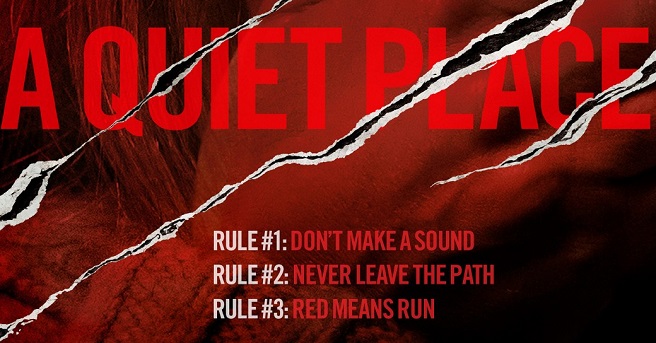
Mix the importance that hearing has in this reality with a family tragedy and you’ve got a recipe for emotional misunderstandings. The people in their family are all that these characters have. Because of this is it crucial that they work together to help make life work. The relationship between father and children, man and wife, and mother and children are each well written and conveyed. Story is as important in this instance as facial expressions in conveying the tale at hand. Not only are Emily Blunt (Evelyn) and John Krasinski (Lee) great at this silent acting, the kids are too. Millicent Simmonds (Regan), Noah Jupe (Marcus), and Cade Woodward (Beau) are able to communicate fear, love, and confusion with painful clarity. The father/daughter angle always gets me in movies and this one is no different. When tragedy befalls the family Regan and Lee’s relationship becomes strained. Simmonds plays the moody teenager impeccably and you are able to see the stubbornness of youth mingle with the fear that being deaf in this world has infused her with. Blunt and Krasinski work as a good team in seeing their kids through these scary times. At one point Blunt asks, “who are we if we can’t protect them?” The lengths that parents go to to raise their children in our reality is sometimes unfathomable and so to do it in this one is even loftier. These two adults have to be 100% aware of everything all the time and mind the children at the same time. Don’t make a noise. Don’t step off the established path. Be careful. Be quiet. Imagine all of these stresses bearing down on a marriage and see the grace with which these two operate. Krasinski is a dutiful husband and father whose sole job is now to protect his family. He is stoic and expresses an intense determination over the course of the film. There is no comedy from him in this role, he is as serious as you can get and he does it wonderfully. Blunt’s motherly role as protector of her babes is touching and the pain and struggle that plays across her face is beautiful.
The intensity of this movie is felt in sight and sound and the lack thereof. There are jump scares and silent scares; creeping dread and sudden “holy shit”. Your body goes on a journey with the Abbott’s and I don’t know how a single person will see this movie without holding their breathe and clenching their jaw. Silence is a powerful tool and to place a whole premise on the notion of having to be as quiet as possible in a film is a welcome tool utilized by Krasinski in getting tension and emotion across to an audience.
***
With all that being said, I hope your theater is a quiet place and I would like to take this moment to encourage you to be mindful of what you are eating if viewing at a Drafthouse type theater. Don’t order something crunchy and be like the guy sitting next to me chomping loudly at tense moments. Just. Don’t. Do. It.
 that ending though