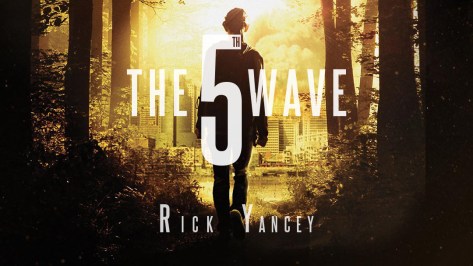
The 5th Wave – Rick Yancey

the5thwavebook


Well wasn’t May just a kick in the pants, lovelies?! Life was hectic in general but to top things off I was bookless for almost the whole month. I think I started like four or five different books. These are books that I will eventually read (…she tells herself) but I needed something with a hook. I needed a tale that captured me from go. You know, that feeling that you get when you open a book and 10 seconds later you’re 60 pages in? That book that calls to you when you’re not reading it…The 5th Wave did that to me. Rick Yancey does an amazing job weaving the overtaking of our planet. This book is horrifically terrifying. For example, are you currently not really a fan of birds? Do you think that angry children are actually super dangerous tiny humans? If you have fears like these, this book might be too much for you. But you should read it anyways because it is. That. Good.

Cassie Sullivan is our primary storyteller through whom we learn about the beginning of the end of the world. There have been four waves so far. First, all of the electricity went out. Second, massive earthquakes and tidal waves cause flooding of every coastline in the world. By this time three billion are dead. Next is a plague transmitted by birds that wipes out 97% percent of the population. As we walk through this world with Cassie, alone and terrified, we learn with her about what comes next in the invasion. It is, at this point still hard to imagine the magnitude of this end of days situation. As Yancey says in the book, a “single death is a tragedy; a million is a statistic.” The scope of this book narrows in and then zooms out again. So, many times, are you reading and just going through the pages and then you stop and reread a sentence and realize how truly horrible some of the things going on in this book are!

There are other strands of narration as well which add to the awareness of the horror. We get in the mind of an alien sniper, who wades through the aftermath killing any human he comes across; additionally you also have Cassie’s brother, someone she went to high school with, and a person who saves her. One element that creates and holds tension throughout is that They look like us (Obvi.) so even though you might know someone, how do you know you know them? You know what I mean? The whole book is like that!! Yes, if you really think hard you can figure it out as you go. But, if you’re just reading this to get excited about suspense that isn’t your standard Every-Distopian-YA-Novel a la:
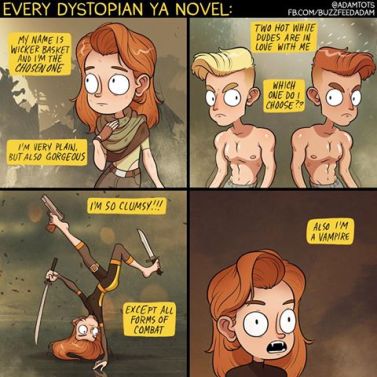
YA Comic

then this is for you! I really was invested in each of these perspectives and what’s more, they didn’t spend their whole section/part being worried about “the girl” and not doing their own shit, as it is, ya know, the end of the world and what not. Themes of keeping promises and love being the primary driving force are present, yes. However, I thought they were done in great ways. There were times when I went, “oh come on!” when it was getting a little too formulaic but those issues straightened themselves out fairly quickly.

While we do get to see these other perspectives, I really appreciated getting to know Cassie’s voice. When we are first introduced to her she is on her own after her brother has been taken by uniformed men and her parents die during two different waves. She is trying to survive in a world in which, as far as she knows, she is the only one left alive. She is strong and focused after not having seen another person in weeks…or is it months? This uncertainty of time is something that Yancey plays around with very beautifully. Characters often think of time in relation to their actions and the happenings around them, seconds into eons when a bullet is speeding towards you, hours into years when you’re left alone in the dark. When you’re solo in the world, things can get screwy. The noticings about time are interesting in the end when you realize the grand scale of these aliens coming from who knows where and how far away…how long has this been in the works? And we as humans can only think in the smallest increments of time.

In addition to the time talk, there is often weighty, lofty things that only get said in books and movies that are somehow just on this side of okay. For example,

“Cassie Sullivan didn’t run…He could see the familiar look of fear in her eyes, a look he had seen a hundred times, the look we give back to death when death looks at us. “

Is quickly followed by,

“His heart, the war.

Her face, the battlefield.”

But it is all okay! I’m fine with goofy lines if the story is strong and the people have good solid reasons to be on these “missions” that they are invariably always on.

The gravitas of what these kids go through – because they are all kids – is disturbing. Imagine all of the adults in the world dying and the kids being taken in by some sort of military unit and being trained to hunt. They don’t know if they are being told the truth (and neither do you), nor are they old enough to really question things. Over the course of the fourth wave, you again realize what is going on and have to occasionally re-read paragraphs. Whether they are made to do these things by humans or Others, going through dead bodies and “processing” thousands for cremation is not something that should be on an eight year old’s to do list. Neither, for that matter, should weapons training and emergency medical/tactical care be subjects that should be taught to six year olds. You realize that these children, who are now parentless, are being guided by people who are not at all concerned for their well being or what is best for them. They are being trained brainwashed to kill. These horrors of the day keep tolling up and these kids are so glad to no longer be on their own in the middle of an alien invasion that they believe everything they are told!

Over the course of the entire book, you think for a section that you have something figured out and then the next chapter can go two ways: you could be wrong or you could be right which is sometimes even more scary. I haven’t read any of Yancey’s other works so I don’t know if he is just always good at suspense but man alive I am glad I fell into this book. There two books which round out the trilogy and I am anxious to start the second. I do know that there is a film that was made on the book in 2016 and I have heard nothing but terrible things about it so I haven’t as much as even seen the trailer. I wanted nothing to taint my experience of the book. This is an action that I am grateful for. There is also a lesson in that: don’t just watch dystopian thrillers. Read them. For an adventure that takes you to the end of the world and frequently punches you in the gut, pick up The 5th Wave.
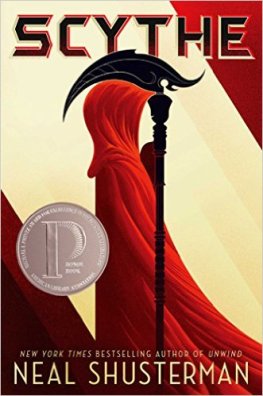
Scythe by Neal Shusterman

Scythe


In a world populated by humans who have conquered mortality, population control must come in some form. Right?

Hello lovelies. I just finished reading Scythe by Neal Shusterman and man alive was it good. A little predictable at times but overall a pretty good read. Humanity exists, ever growing and never dying, in an age where, once you reach your height of outward age, you “turn the corner”. Refreshing yourself body and keeping all of your mental faculties the same. Thus, someone you meet who is 98 might look like they are 25. Over and over again. The age before is known as the Age of Mortality where things like antibiotics were necessary and falling off a building wasn’t sport it was suicide. The characters in the book are far enough removed from this age to find the concept of a headache beyond imagining.

Citra Teranova and Rowan Damisch are our primary threads throughout the course of the novel. However, there is input from Honorable Scythes that separate the chapters, taking the form of journal entries (more on this in a bit). When we open, Honorable Scythe Faraday has separate interactions with both of our hero(in)es. Due to these meetings, both subsequently become apprentices to the scythe. At this point you might be asking what exactly does that mean? Why do I keep repeating that word? Well, scythes are the only people allowed to kill in this reality. Because of the ever growing, never dying population, control must be extolled in some manner, right? Scythes are legally sanctioned to kill and they have quotas to meet (just like all of us in our real jobs! Scythes are just like you and me!) (Except they’re really really not.). Citra and Rowan say good-bye to their families and begin their training in the arts of killing.

One of the things that I like about this tale is that even though these people are not able to die (they call it “splatting” after which they are taken to revival centers which do exactly what’s in their title), they still view life as precious. Taking it permanently gives them reservation. They are not impervious to their consciences. The same cannot be said of all characters. Those peeps are juicy and crazy in equal amounts. Anyway, Rowan and Citra are training under Faraday when some mischief happens and they are sent to be mentored elsewhere. What I haven’t told you is that not all of Scyethdom is happy with the fact that the scythe has taken on more than one apprentice. In fact, it is something that has never been done before. As such, it is determined that they will not both be accepted into the fraternity. One will have to glean the other. These humans have become so detached from societal killings that they are no longer referred to as murder but as being gleaned.

All of this happens pretty quickly in the novel and it is mystery and intrigue and life lessons from then on. The pair are made to part and train with different scythes. What is interesting here is that we see the training style of not just one scythe but three (potentially more…read and find out). These three scythes are the ones who make the journal entries between chapters, mentioned above. This give us a chance to see not just Citra and Rowan’s views of this vocation, new and inexperienced, but also the older generation who have been doing this for many years and have a very different perspective.

What transpires from there in the story is too good to spoil. Just know that these characters, in particular Citra, are very relatable. Readers get to experience so many different thought processes about what it means to be legally authorized to kill. When you think about what they are doing and the fact that they are in their mid-teens on top of that, it really gives you pause. Not only are they teens but they are teens amongst elders centuries old. Society has gotten to the point where the Thunderhead (having graduated from a cloud) is the foremost authority on societal control. There are no more cops because the Thunderhead prevents crime. There is no more government because it was proven they were all too corrupt to lead and the AI could do it better. Countries are now regions, continents grouped in accordance with geography. The world that Shusterman creates has an explanation for all of the ways the world has evolved.

At first I was worried that it wasn’t going to be good and be really predictable. But there are a couple of twists that throw you off course and make you recalibrate how you view this world. For example, the scythes to which Citra and Rowan are transferred both operate very differently not only from Scythe Faraday but also from each other. The moral dilemmas that they face independently turn out to be really fascinating to read through. It is very obvious to me why this book was on so many Best of 2016 lists last year. Pick it up and give it a read. Would you be able to kill for the greater good?

The Fireman by Joe Hill

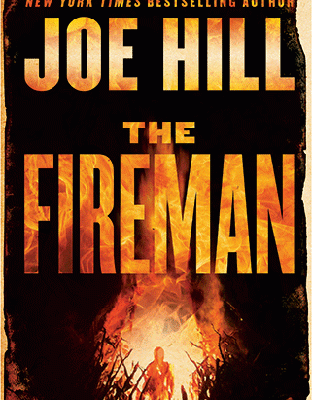
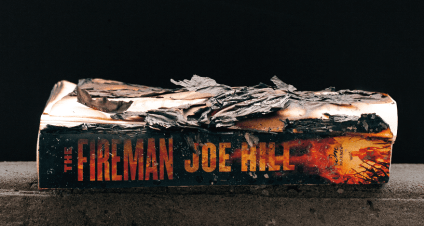
Well y’all. I did it. I finished the behemoth tome that is Joe Hill’s latest, The Fireman.

What. A. Journey.

<<Spoilers ahead. You’ve been warned.>>

Tapping out at 747 pages, The Fireman follows Harper Grayson née Willowes as an airborne spore destabilizes the world. We sit with Harper and Jakob in their New Hampshire living room in the first chapter and watch as the Space Needle in Seattle burns on the news, watch people jumping out of windows to escape the all encompassing fire that makes up these pages. The sickness is Draco Incendia Trychophyton and it creeps into you without causing any harm at first. You breathe in the infected air and slowly, lines begin inking themselves in intricate patterns; one here, one there. At first. Then it covers your whole body and your insides reflect your outsides; the Dragonscale begins impacting your very make-up.

If you paid any attention in Latin, or have any Harry Potter knowledge you recognize the first word in the disease’s name. Draco, dragon. It’s pretty easy to infer Incendia after that. When the spore begins feeling (feeling?) that the host is threatened (anxiety, sickness, fear) it begins to save itself. The host, the human, the body combusts and burns from the inside. Our lovely Harper is a school nurse who, after schools shut down and institutions begin crumbling (which happens pretty quickly as this book spans a little over nine months…) begins volunteering at the hospital where the sick and infected are asked to stay/are corralled and kept. It is in this setting that we first meet three of the four people with whom Harper will primarily share this journey. First is the Fireman.

Our title character is charming and aggravating (as most are) and British (think Rufus Sewell). And as the world is breaking down and falling apart this fireman is bringing in an injured, deaf boy Nick to the hospital (the whole time I pictured Ben from Stepmom). Neither of them seem to show any visible signs of the ‘scale, are not complaining about the usual symptoms. After much debate, they are waved through to the small portion of the hospital still seeing non-‘scaled individuals. We don’t see them again for a bit but fret not fellow swooners, the Brit comes back. Next, we meet Ms. Renee Gilmonton who is the just the absolute sweetest lady. She reads to her fellow infected hospitalmates, primarily the children; keeping them calm and relaxed (Renee reminds me of Oprah, not glam Oprah, but the Oprah of that famous camping trip with Gale).

Anyways, now that you’ve got some visuals, let us move right along.

We quickly discover with Harper as our guide that she is not only pregnant but she is also infected and boy howdy let me tell you, Jakob is not happy about this combo. So not happy, in fact that he actually blames her for having a Florence Nightingale type syndrome in which she can’t leave people be. Yeah, because that’s a bad thing. Jakob is a grade-A-Scott-Disick-type-douche; something that is apparent from the first time we see how his name is spelled. After he leaves Harper alone for in their house for days (weeks?) he comes back and suggests they kill themselves. Yup. She has it, so he infers that he has it. There is no conversation of should we or shouldn’t we, no concern for the fact that there is also their unborn child to consider, nada. Let’s just do the damn thing is pretty much his attitude. The reader is able to very quickly realize that not only is Jakob an ass but he is also legit crazy. His decision on the matter has been made up and as Harper tries to get away from this nutcase, with whom she has very quickly fallen out of love, she runs UPSTAIRS to escape him. Because that always works so well in the movies, right? I won’t say anymore on the manner of her escape because it is super tense and I would like you to feel that anxiety along with Harper as you read for yourself the measures she takes to get away from him.

And obviously she escapes because there are still 700 pages left in the novel.

JoeHill-1600x856.png

After our heroine ditches the psycho we arrive at Camp Wyndham which is where the second act begins. Where better to hide a growing group of infected than an abandoned summer camp? It really is a great setting. Here we meet Ally, Nick’s older sister. Ally, Nick, and their family began bringing in infected to the safe haven of Wyndham pretty early into the epidemic and this is where Harper finds community, safety, and a chance to breathe…and sing. This is a community that is no great risk of burning up for they have found refuge in harmony.

Throughout history, fear has always inspired hatred and that is incredibly prevalent in the world of The Fireman. Society very quickly devolves into an “us and them” type divide and the small bits of news we hear on the mostly static filled radio demonstrate this. Cremation Crews are formed and murder goes from frowned upon to commonplace. Throughout the whole book, Hill keeps his characters very black and white making bad guys and good guys very easily discernible (with an exception towards the end of the second act). The divide between good and evil and right and wrong is prevalent throughout. This is something that goes beyond the characters and extends to morals and beliefs. What is right to a “bad guy” is not what is right to a “good guy” but who is to say which is which? If you were not infected and viewed those who were as a threat to your well being and that of your family’s, then you would protect yourself in whatever way possible, right? If you are infected but not dangerous you would want to live and not be put down/out of your misery because you wouldn’t be miserable. Perspective is very important in this tale despite the fact that ours as readers never shifts.

Sprinkled through the middle of the book are mentions of an island that has remained under the care of the CDC despite the collapse of all other official acronymed orgs. Martha Quinn’s island (yes, that Martha Quinn) promises safety and developments and doctors. Sounds too good to be true; a point made by several in the Wyndham community. However as time goes on and disastrous events occur, it is clear to our little band within the camp that they need to get to this island one way or another. Harper is particularly keen to get there as it is unknown what the ‘scale will have done to the baby. And so, as the second act closes with a bell tolling, the final act opens with our heroes on a somewhat forced and hasty journey to the mysterious island. Miles and miles are crossed and mishap after tragedy follow our travelers.

Up until now there have been some pretty good plot twists, real solidly developed characters, and fairly good pacing despite the book’s page count. There are amazing pop culture references throughout (his description of how J.K. Rowling meets her end is gut wrenching). However, towards the end, the last 100/150 pages or so, things begin to get pretty predictable. While this is an obvious bummer, you’ve got to give Hill props for keeping things exciting and juke filled for as many pages as he does. The Fireman offers readers adventure and romance, heartache and danger, terror and hope. There are factions of mankind that turn into despicable monsters and there are those who are able to keep their compasses pointed North in hopes that not all is ruined.

Hope burns fiercely in Joe Hill‘s The Fireman.