
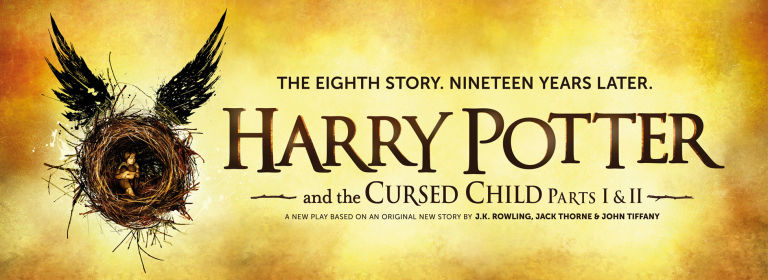
Harry Potter and the Cursed Child- Parts 1 & 2

gallery-potter-cursed-child-poster-1

I have, for many reasons,been putting off reading this playbook. When the series ended, I was content with its closing and was even glad of the epilogue showing that light can come to those who have faced the dark. This is one of the main reasons I was hesitant in picking up any sort of continuation of the story. That being said, I do think that there are so many tales that can be told from this world, which is why I am so excited about Fantastic Beasts coming out this week. So it was with much skepticism that I dove into Harry Potter and the Cursed Child.

HPCC was written for the stage by Jack Thorne and was based on an original story created by Thorne, J.K. Rowling and John Tiffany. A couple decades have passed since our trio left Hogwarts. Like we learn in the epilogue, Harry and Ginny end up together as do Ron and Hermione. Their kids are going off to school and it is here that the Potter’s middle child learns that he will be in Slytherin along with a boy who seems to be his only friend throughout: Scorpius Malfoy. The tale focuses on a couple of different parental relationships, how the younger generation are impacted by the past actions of their parents, and the importance of thought before action.

Albus Potter is the middle child. He often feels over looked and under appreciated. One night, in a heated fight, Harry accidentally comes back with a retort to the effect of “I wish you weren’t my son.” Ouch. This has a noticeable and obvious impact on the boy. Another important argument (this one Albus overhears and is not directly involved in) is had between Amos Diggory and Harry in which Amos blames Harry for Cedric’s death. All these many years later he is unable to accept the loss of his son and dwells on the fact that he was the “spare”. Collateral damage. The feeling of being the spare really resonates with Albus and he decides that preventing Cedric’s death would be a good course of action for setting things straight.

I don’t really understand this logic. This mission of his just doesn’t reeeeally make sense.

At this same time a Time Turner is discovered and taken in by the Ministry (oh yeah, Hermione is Minister for Magic, whaaaa?!) and isn’t this just perfect since Albus has decided that going back in time is exactly what he needs to do. How. Convenient.

So he and Scorpius go back in time to the Triwizard Tournament (a.k.a. book four). And wouldn’t you just know it but they mess shit up. Like really really badly. What frustrates me so much about this idea of theirs (which the story is largely based around) is that they are so inconsiderate of their actions and don’t even pause to think what undoing something that had happened two decades prior would do to the present. Preventing someones death that far back….I can’t even begin to fathom how many wrinkles that would produce. Which is why it seems so implausible. These kids have grown up in the wizarding world. Don’t you think they would be aware of the repercussions that something like this could have? I can see how there would be a counter argument formed: if they are living in a world in which all Time Turners had been abolished (/destroyed) maybe the perils of time travel weren’t taught to them. I don’t know. What I do know is that their ignorance sure does not create bliss.

When they get back to the present all sorts of things have gone haywire. So what do they do but decide to go back AGAIN to right what they’ve wronged. This time they travel to the second task and guess what…they eff some more shit up. When they get back to the present some people (including one of our main characters) weren’t even born! That’s how messed up things get. Also, Voldy is alive and well in this new present. Great. Now, to fix this, time must be travelled through…again.

This goes on and it is a total of four times that our characters traverse the time stream. Unbelievable.

A complaint that I have heard/read from many Potter fans is that the way Harry treats Albus doesn’t match up with the character we all grew up loving. I totally see where these thoughts are coming from. There are definitely some lines that I had to reread and recheck who the speaker was because it just seemed so out of touch. However, to that I say: Harry is a parent in this time. We have never before seen him in this role. So obviously there are going to be new facets of his character with which we are not as familiar. I mean, 20 years have passed, ya know? I definitely hope that some my 17 year old self’s traits evolve by the time I’m 37 (I’m about midway through that evolution and think things are going quite nicely…but I digress).

When all is said and done, I did not hate the read but I was not over the moon about it. It is very easy to get through because it is dialogue and stage direction and not any sort of expository “stuff” or narration. I would definitely encourage all Potter fans to check it out but I would caution them to go into it with an open mind. This is the story of Albus Potter despite Harry’s name being in the title. This is a play and not a book and as such should be viewed for what it is: a different medium. This is extensive fan fiction flushed out by Rowling and not penned by her. This is one to add to your Rowling shelf in the hopes that more stories (written by her or not) are to come.


This month in literature…

weekend-is-all-booked

Well hello there. I haven’t seen you in a while….totally my fault. Man, the past month has been crazy. To further interrupt the regular rotation of posts I’d like to tell you all about the amazing time I have had in the literary world over the past five weeks.

To kick off the month of October, the Texas Teen Book Festival was held. The day long celebration of the YA genre hosted 35 authors on the Saint Edward’s University campus. As I was volunteering, my day started just before 7 am putting up parking signs and helping to make sure school bus traffic went smoothly. Mindy Kaling’s book signing was the first event of the day which was to begin at 8:30 am. When I arrived (before the sun) there was already a crazy line waiting filled with so many amazing fans. Working book signings is one of my favorite things to do because the people are always excited to see these authors. YA fans are so appreciative of the authors in this genre and vise versa. Each author is so willing to converse with readers and makes sure that their experience in those two minutes is genuine. They have the rotation of these lines down to a science and know how many signatures they can do in x amount of time. It’s amazing. Another reason that this festival is fun is because of the games! Authors play trivia games, have races and contests. In addition to the panels that are held, many of them gather in the university’s gym and by the time you leave your stomach and face hurt from laughing so hard for so long. The Texas Teen Book Festival has been in operation and in a state of growth and evolution since 2009. The TTBF “fosters a community effort to celebrate and promote reading and writing by connecting teens to local and award-winning authors, whose writing spans across genres and interest level.” It is a wonderful experience to witness this first hand. While working a signing this year I overheard a conversation with Kirkus Prize nominee Traci Chee (The Reader) and a young reader who was probably in 7th or 8th grade. She told Chee that she wanted to be a writer and asked her very earnest and well put questions. How she flushed out characters. How to create a foil. This conversation went on for probably 20 minutes or so altogether. When another fan would walk up, the girl would move to the side and then come back and continue inquiring. Seeing this exchange made me so happy and that is the whole goal of such a festival: to inspire young minds and encourage them to keep reading, keep asking questions, and keep imagining.

The next big event: the Kirkus Prize. To read the full list of nominees and articles about each, visit the Kirkus Reviews website. When I was a young reader of about 10 or 12 I fell in love with this series that was about princesses and dragons. I have since forgotten (much to my annoyance) the name of the series and instead remember that the Kirkus review that was on the back of the book had been high praise. From that book on I didn’t buy a book unless it had a review from Kirkus. Imagine, then, how amazingly, stupendously, wonderfully awesome it is that I now work for Kirkus and speak with independent authors and small presses all day every day. Being part of the team who put together the ceremony for the Kirkus Prize was an experience almost beyond words. The ceremony was held in downtown Austin, Tx with a view of the skyline and a view of the river. Six authors in fiction, six in non-fiction, and six in youth literature (YA, middle grade, and picture books) were nominated for outstanding work in their genre. Making my way in and around the crowd, I spoke with several of the nominees and people within the industry that I have admired for so long. When I found myself in the presence of Jason Reynolds (who later in the evening won the award for YA) I totally fangirled on him. I was able to speak to him about his process, his upcoming projects, and about how great his work is. Again I witnessed the wonderful generosity of authors who want to talk about books just as much as you or I. The Kirkus Prize is the largest monetary prize in the literary world and as the first award of the season, it tends to set a precedent for nominations for awards that follow. The prize is $50,000 to each winning author and is awarded to the title that the judges feel displays exceptional merit.

The following evening was the 21st annual Literary Gala which is hosted by the Texas Book Festival. The gala serves as a fundraiser and is the driving factor in keeping the large festival free and open to the public. This was the first time I had been to anything that was coined black tie. Attending the gala this year was an amazing personal accomplishment for me as it was at this exact function the year prior that I met my future boss and started my path to Kirkus. Last year I interned for the festival and was on the outside for the whole gala. This year I was sitting at the Kirkus table and got to wear a fancy dress, eat an delicious three course meal, and listen to some pretty great speeches. One of my favorite aspects of the festival is the Reading Rock Stars program which goes into underprivileged schools in South Texas. They schedule author talks at these schools, bringing in authors and illustrators to talk to kids about what it means to them to be able to write/draw for them and how they too can do it! Each child receives a book of their own to keep and a lot of the time it is the first time that they are given a brand new book of their very own. To hear this program talked about at length during the gala was heart warming and inspiring. First Lady Laura Bush started the festival in 1995 and it has grown exponentially each year in both author and public attendance.

This month has been hectic and stressful and rewarding. It has been long and involved multitasking on a whole different level. And it was so worth it. Never before have I felt so satisfied with myself. I have worked hard for many years now to become part of this world and now that I am, I can’t imagine being anywhere else.

Thank you for reading my ramblings and for visiting my site. Next week we will return to our regularly scheduled programming.


The Girl in the Spider’s Web-David Lagercrantz

spiders-web


Hello there book lovers. Today we will be diving into The Girl in the Spider’s Web which is book four in the Millennium series. Before diving into the review and analysis, however, I would like to discuss the amazing journey that has transpired behind the scenes over the course of this series’ existence.

Stieg Larsson created the world in which the magazine Millennium exists. It is run by  Mikael Blomkvist and a savvy team of reporters in Sweden. Blomkvist, over the course of the first book, meets Lisbeth Salander who is a hacker and an amazing one at that. Larsson stated initially that he had enough material for the series to span 10 novels though his untimely death in 2004 seemingly put a halt to this idea. After his death, The Girl with the Dragon Tattoo was published in 2005 and was incredibly well received. The following two  years, in 2006 and 2007,  The Girl Who Played with Fire and The Girl Who Kicked the Hornet’s Nest were published respectively. The ’07 publication of Hornet’s Nest was the last of the complete manuscripts Larsson left behind.

It was at this time that Larsson’s publishing house Norstedts Förlag was at a cross roads. Leave the Millennium series as is or continue the work that Larsson began by passing the torch onto another writer. However, it was not as simple as that and it is here where the literary soap opera gets juicy. You see, Larsson’s longtime partner Eva Gabrielsson was in possession of all of Larsson’s outlines and notes and partial manuscripts. The two had never married due to safety issues stemming from Larsson’s activism and journalism.  The will Larsson left behind had not been witnessed or documented properly and because of this, his estate fell into the hands of the deceased’s brother and father. They were on board with the continuation of Larsson’s series however Gabrielsson staunchly opposed the idea. A very public dispute ensued. In the end, the Larsson’s gave permission to Norstedts to proceed with a fourth installation of Mikael Blomkvist and Lisbeth Salander’s escapades and at the very end of 2013 it was announced that David Lagercrantz would pen the title. In August 2015 The Girl in the Spider’s Web was published worldwide followed by a release the following month in the United States.

That being said, let us now dive into the title in question:

This was the first time that I listened to an audiobook. I know, I know, get with the times. I am a huge podcast fan and love talk radio, but for some reason I had never listened to a book on tape file. Man I loved it!

The Girl in the Spider’s Web was written by David Lagercrantz and was recorded by Simon Vance. I was apprehensive about this title because I have been such a fan of the series and to hear that another author would be taking over is enough to make anyone skeptical. I think Lagercrantz did a really good job though! There are a lot of negative reviews on the title and so that only added to my apprehension but I was pleasantly surprised to find that I was of a different mind.

Firstly, Lagercrantz did something that I noticed fairly quickly in that he made Mickael Blomkvist much more believable as a real person. How did he do this, you might ask. Well, for starters, he did not have every woman Blomkvist encounters throw herself immediately at our main character. This was so refreshing. Previously, Blomkvist had been such a ladies man that by the second and third book it was almost farcical. Every. Woman. Like, what? I know he is charismatic and that he is a reporter so he has a certain je ne said quo but cooooome ooooon. So that was a definite improvement.

This was a super important shift that I found very refreshing and humanizing.

But it wasn’t only this detail that made for an obvious departure of Larsson’s writing. The story itself unfolded in an interesting way. Before I dive into that, however, let us get a brief overview of The Girl in the Spider’s Web. 

There has again been a lapse in time from where the previous title left off, as has been the pattern for the series. We open with Millennium magazine not doing too well and rumors run wild that Mikael Blomkvist is now a washed up journalist who is feebly riding on the waves of his past success. Timing is everything though and a scandal soon begins to unfold. Scientist Frans Bolder is murdered in front of his autistic son and it is later determined that one of his computers is missing along with the A.I. technology that he had been working on. At the same time, the NSA in America is hacked. Something no one thought possible. The hacker players in Spider’s Web are very interesting and it is here that we learn that Lisbeth Salander just cannot escape her past and the family that she so deeply despises. You see, it is revealed early on that Lisbeth’s twin sister is in on the plot. This I loved and will get into more detail on in a second. Blomkvist gets involved because the night that Bolder was killed he had called the journalist saying that he had information that needed to be shared and that he was nervous about who wanted this knowledge and what lengths they might go to to get it. Thus begins the unraveling of what his technology did, who wanted it (both criminal and government), and how Lisbeth Salander fits into the equation.

There is a writing technique that Lagercrantz employs frequently and with great affect. He goes through a scene/time frame from one character’s point of view and then he alternates this view and retells the same moment from a different perspective. For example, Bolder’s death scene. We are outside the house with the police officers who have been assigned as protective detail for Bolder. They encounter someone outside and are speaking with him when Blomkvist arrives. The next passage is seen from inside the house as the murder is taking place. The killer runs out of the house and slams into the newly arrived Blomkvist as he makes his way up to the house. This happens again and again throughout the book and it is very well done. These time frame parallels enable us to have a fuller understanding of a particular scene and point in time. This is also a great tool because it allows a tense moment to play out from different vantage points and then it is easy to cut away from the tension and switch to another which creates cliffhangers in interesting spots. Very exciting.

As we dive into the hacker aspect of Spider’s Web we get further insight to Lisbeth’s past; something that I always enjoy and which was a particularly important through line of Hornet’s Nest. In book three we gain a deeper understanding of Lisbeth’s father and the terrible things he did to her and her mother that formed the Lisbeth we all know. Closed off, man-hating, curious, incredibly smart, and somewhat on the spectrum (not that her dad caused her to be on the spectrum but how his behavior impacted her). So then in Spider’s Web we meet and get more info about her sister Camilla who had briefly been mentioned in titles past. Camilla is described as a polar opposite of Lisbeth. She glows with beauty, has charm for days, and is able to persuade anyone to pretty much do anything. She is their father’s heir to his criminal empire and she is a cold and nasty piece of work. Seeing the contrast of the sisters becomes a big part of the third act as we find out more and more what Camilla is capable of. At the same time, we see a more tinder side of Lisbeth than has been expressed so far.

After his murder, Lisbeth takes Bolder’s son August into hiding as he was a witness to the crime. Despite the fact that he doesn’t speak, he is a savant in numbers and drawing. He saw the face of his father’s killer. While on the road with the boy, Lisbeth begins trying to open him up. Lagercrantz does this in a very real way. Lisbeth does not speak down to August, does not try to pander to a child. She speaks to him like a fellow human and it is very refreshing and eventually something comes of it in that he draws his father’s murderer. In true Lisbeth fashion, she just wants what is best for the boy and his mother and there are parts of the story that transpire between the three of them that are solely known by these three characters. It is special and I really enjoyed seeing how that part played out.

Going back to Lisbeth’s sister, we see how deep seeded their hatred for each other is and are taken back to their childhood. It is here, in the past, that Lisbeth’s hacker name Wasp is given explanation. The Marvel universe is brought into play and we learn how important the Janet van Dyne character and the Avengers are to Lisbeth. As Camilla becomes more nemesis than sister, she begins to call herself Thanos. This pull from pop culture was the only thing that stuck out as odd to me and while it is interesting to hear about the psychology behind this, it took me out of the story a bit to have something so American mentioned. I am not sure if that was always the origin of the Wasp handle; it makes a lot of sense when the backstory is given but I wonder if that was Lagercrantz’s doing or taken from notes of Larsson’s.

Overall, The Girl in the Spider’s Web was a really great listen and Simon Vance does a great job with all of the Swedish that occurs throughout. I am really interested to see if he continues on with the series or if the publishing house will do each title by a separate author. The sales for book four have been pretty good and the title stayed on bestsellers lists for 16 weeks where it sold over 200,000 copies in it’s first week! Lisbeth Salander is such a compelling and stimulating heroine who stands up for the rights of women, what is right and just, and doesn’t take any shit from anyone. I hope that these numbers will parlay into a book five and that we won’t have to wait eight more years for it!

millenium_trilogy_mar3