
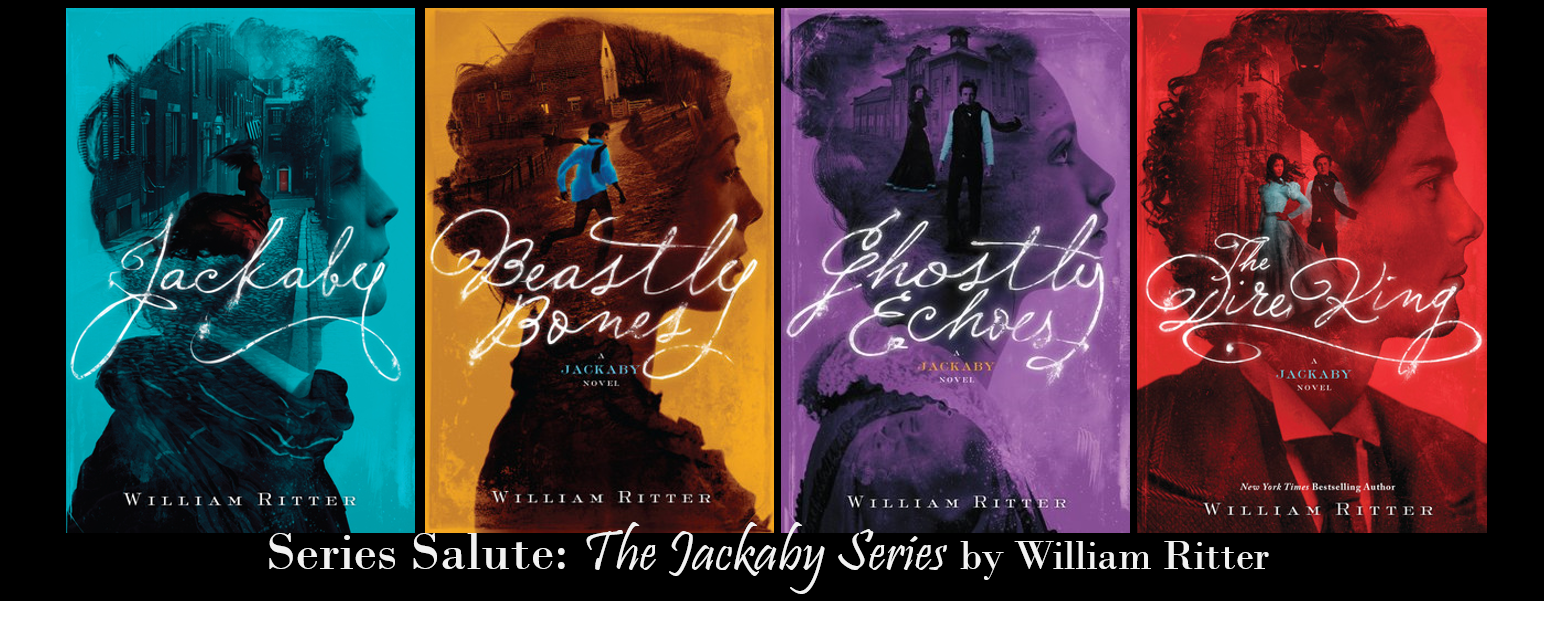
** Tiny bits of spoilers lie beneath this sentence. **
There are times, lovelies, when a series seems harmless, there are times when a title sits on your shelves for months maybe even years and you give no second thought to it. There are times when you finally pick up one of those books and it is just as boring and uninteresting as you had thought. As avid readers, we get used to the spines on our shelves and whether we have read them or not, they are our trophies, our scores and finds, our prizes. Then there are other times, where you finally crack one of those spines and it sucks you in like spell has been cast. You are able to think of nothing but the characters and their adventures and when you do not have it open in front of you the book is still on your mind and in your head calling out to be reopened and dived into once more. The Jackaby novels are very very much the latter of those scenarios. I don’t think there are enough positive words in the English language for me to gush enough about how much I loved this four part series. But, for your benefit, I will try.
Abigail Rook (mentioned in the previous post regarding female leads) is our narrator over the course of these tales. As the series opens she is fresh off the boat from a failed paleontology dig and is in look of a fresh start – immediately establishing her as an adventerous woman. One of the first people she meets in New Fiddleham is Jackaby himself although it is not until a few chapters later that we are properly introduced to him. By the time he officially hires Ms. Rook to be his assistant we have already visited a crime scene with him and seen that Abigail is not as prim and proper as many other ladies of the time. She is incredibly observant and determined and as readers we get the sense very quickly that she is going to be a good and reliable narrator. R.F. Jackaby is a paranormal investigator and the world’s current Seer. It is his duty to use his Sight to keep the peace between [mostly] oblivious humans and the magical beings who secretly populate our world and exist among us. He has been at it for about 20 years and has made quite a name and life for himself in New Fidddleham. His offices and housing (as well as Abigail’s once she is hired) are in the house of a deceased woman named Jenny Cavanaugh. Jenny still presides in the house as the resident ghost and her emotional journey is really amazing. (More on that point in a bit.) These are our three main characters and their relationships to each other and with the magical community at large become central to the story…or is the story central to them?
One of the things that I think Ritter does so well in this work is that the overarching plot from start to finish is so cohesive. It is bananas! Something so simple and well structured makes the storytelling so amazing. As readers we first get hints of this larger thread that connects everything in book two. We are able to see that the events in book one weren’t the beginning and that strings have been being pulled puppet style for years. This type of tight knit, no lose ends story telling is refreshing in it’s simplicity (as I’ve already mentioned and will probably mention again). There are red herrings and twists and turns and if you really pay attention it is easily figured out but that is not the point. The point is that Ritter takes this tale as old as time of good and evil of us versus them and gives it a positive female perspective and makes it engaging for young readers. So far, all of these books (with the exception of 4 because it is brand new) have topped Year’s End lists and have been super positively received.
While there are many supernatural points in these stories, there are also parallels for very real issues. Many of our other worldly characters have glamours on themselves so that they appear human to the untrained eye. One character who does not have to do this is Charlie Cane/Barker as he is able to transform at will from a human to a (not naming his creature as it is a spoiler). While this ability allows him to lead a fairly undetected life, events in book one make it necessary for him to reveal his true self during which time townspeople see him and demonize him. The hatred and fear exhibited towards Charlie is only a prelude to the racial prejudice that many of the townspeople have once they find out there are many more fantastical beings among them. In a scene in book four, all of the jail cells are full of creatures who have done nothing wrong except not being human. There is no way to not draw a parallel to the segregation of our races here in America and the fear that many have of people and things who are different and unknown. What Jackaby shows us is that there is nothing inherently wrong with you for being different, we are all just who we are.
Another character who helps us see that it is okay to be who you are is Miss Lydia Lee. While Ritter never goes into explicit detail regarding labels, we are let known that Lydia Lee is a man who likes to dress as a woman. When we first meet her, she is being attacked physically and verbally by men who do not understand her; who are uncomfortable with her decision to live her life the way she has decided. What I thought was particularly amazing about this is that these stories take place in the early 1890s and I don’t feel like, when you go that far back in a setting, you see anyone represented who isn’t white and straight or black and a slave. The fact that Ritter takes the time to make it clear that Lydia is who she wants to be whether anyone else likes or understands it is really wonderful.
Lastly, as mentioned above, Jenny is another example of a larger metaphor. Jenny was murdered and her death plays largely in to the grand scheme of things once it becomes clear that so many “huh that was weird” occurrences start becoming connected. While Jackaby has tried many times over the years to help Jenny solve her murder and move on to the afterlife, a big issue in preventing this closure is that Jenny seems unable to leave the house. She is able to exist within the walls and is able to touch things/items that belonged to her in life but that is the extent of her physical capabilities. Once Abigail comes along, she and Jenny really get to work trying to help Jenny get out of this cycle of disappearing any time she tries to leave the house or dropping objects that aren’t or weren’t hers. This behavior seemed to me to be a metaphor for depression and a bit of agoraphobia. With the help and patience of Abigail she is able to overcome this. However, it is not an easy task and is by no means minimized or dismissed. Her peers are encouraging and inclusive even when Jenny is down on herself. This is super important and really compelling.
While these themes and metaphors are very important, something that is even more central is the building that Ritter does throughout both in terms of the world and it’s characters. We start with knowing as little about the world as Abigail does and through her eyes and Jackaby’s tutelage we gain perspective and become woke to the intricacies and magic surrounding us in every day life. We start off naive and unaware and become entranced and enlightened. There are histories alluded to and stories that exist in this world however it never feels like we are being preached to or talked at. Due to his insight Jackaby provides us with information on the world that Abigail might not have come by on her own. We are, at times, taken out of new Fiddleham and the into other communities (both of this world and the next) that are connected to the story, we are taken back in time in memories of characters. These flashbacks (and I hesitate to call them that as they are not cheesy exposition but well done exposition) provide an expansion not only of the world but of how each of these people fit in to it. Motivation is shown, not just action. By mid way through book one I was already longing to be Abigail and Jenny’s best friend and to be part of Jackaby’s team. These are fully realized people with hopes and dreams and I that is not an easy thing to do nor is it always achieved by writers (especially so quickly).
I think the last time I got this sucked in to a series and devoured it as quickly was two Christmases ago when my partner introduced me to Susan Collin’s The Underland Chronicles. These four books (Jackaby, Beastly Bones, Ghostly Echoes, and The Dire King) are impeccably written and really smart. As Jackaby says, “I have never found a book that did not have at least a little magic in it…They can’t help it.” If you are on the prowl for your next obsession, look no further!
 that ending though
One thought on “The Jackaby novels by William Ritter”